[00:00:00] Thomas Picard: Well, I thought it was a smart idea to have a standoff with the SWAT team of Connecticut.
[00:00:10] Cristina Quinn: Okay. All right.
[00:00:13] Thomas Picard: Go on. Yeah.
[00:00:16] Cristina Quinn: Initiating a standoff with the SWAT team is not what I’d put at the top of my good ideas list, but like a lot of bad decision-making, alcohol was involved in this story.
[00:00:27] Thomas Picard: The last five years prior to prison, my drinking went from social drinking to drinking heavy, to drinking all the time.
So it got ahold of me, and it destroyed my life.
[00:00:43] Cristina Quinn: Do you know what prompted it?
[00:00:45] Thomas Picard: Boredom is a huge thing.
[00:00:49] Cristina Quinn: You don’t like being bored?
[00:00:50] Thomas Picard: No. Bored is bad.
[00:00:53] Cristina Quinn: But how did the SWAT team get involved?
[00:00:55] Thomas Picard: I called them up.
[00:01:00] Yeah, I called them up and told them I was gonna blow up the whole police department.
[00:01:03] Cristina Quinn: Oh, no.
[00:01:03] Thomas Picard: Yeah.
[00:01:04] Cristina Quinn: And so which town was this in, or city?
[00:01:06] Thomas Picard: Madison.
[00:01:07] Cristina Quinn: Okay. So wha… I’m guessing you were really… you were completely loaded.
[00:01:13] Thomas Picard: Totally.
[00:01:14] Cristina Quinn: And so you… any idea, sort of like, do you remember making that phone call?
[00:01:18] Thomas Picard: No.
[00:01:19] Cristina Quinn: Okay.
[00:01:20] Thomas Picard: Nah.
[00:01:20] Cristina Quinn: So you call them up, you threaten to blow up the police department, and then moments later…
[00:01:26] Thomas Picard: So I was… not only did I own my own water well drilling company, I was a part-time gun dealer. Legal. Legal guns. And I had 300 guns, and they knew that because they were all registered. So when they came to my house, the whole SWAT team came to my house, and I wasn’t having it.
You know, so…
[00:01:47] Cristina Quinn: What do you mean you weren’t having it? I mean, what does that mean for a gun dealer?
[00:01:50] Thomas Picard: I wouldn’t let them into my house. I was ready to have a shootout.
[00:01:54] Cristina Quinn: So were you actually, like, getting… Like, were you loading guns?
[00:01:56] Thomas Picard: Oh, yeah. Loaded, ready to go.
[00:01:58] Cristina Quinn: Thomas, that’s, that’s [00:02:00] wild.
So this is happening. You had… You were very drunk. And you thought, clearly at the time, you were thinking having a standoff with the SWAT team is the most sensible thing to do right now.
[00:02:13] Thomas Picard: Obviously, I thought it was a good idea. Looking back now, I mean, duh.
[00:02:19] Cristina Quinn: Duh. Okay… so, okay… so then, I’m just gonna take a moment to just sort of…
I’m picturing it, and it sounds absolutely bananas.
[00:02:31] Thomas Picard: Yeah. I made Channel 8 News.
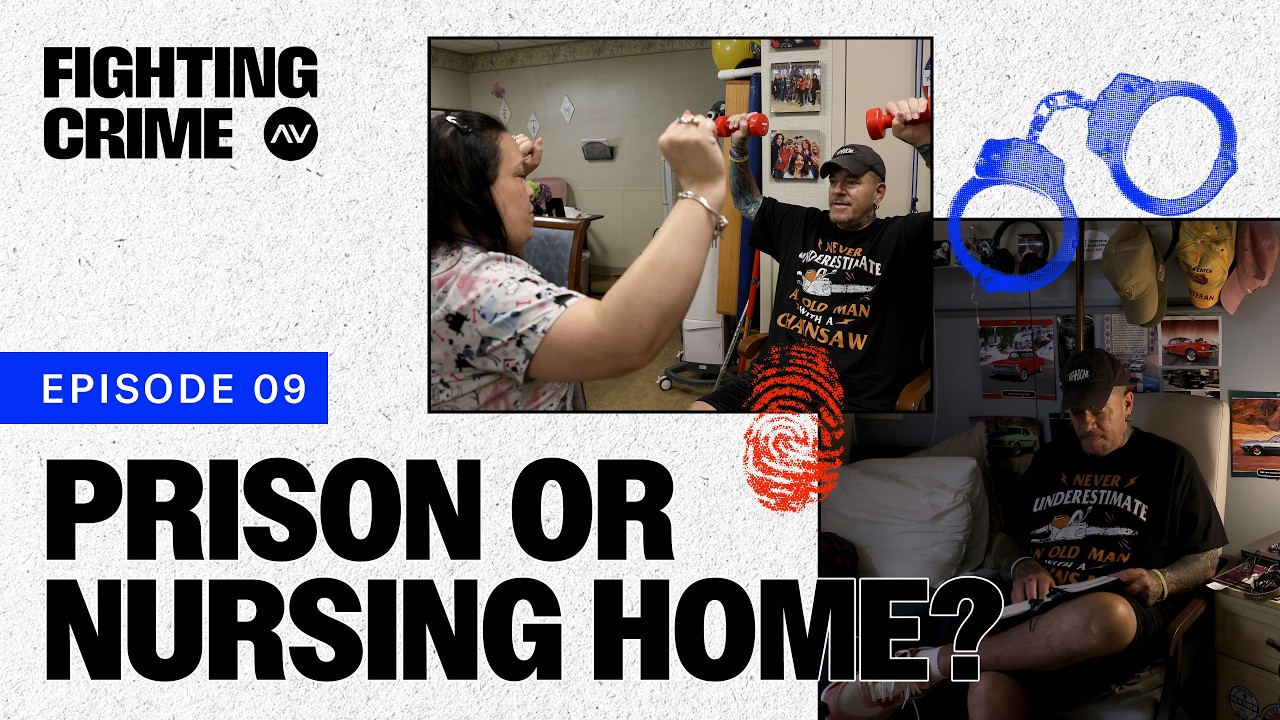
[00:02:35] Cristina Quinn: This gentleman is Thomas Picard. He’s an ex-Marine in his mid-50s with a salt and pepper goatee and mustache. He’s about 5’10. He may be a little taller than that, but needs to lean on a walker for support. Tom’s also got double piercings in both ears and tattoos on his hands that crawl up his arms, neck, down his back, legs, you name it.
On this day, he’s wearing a baseball cap and a T‑shirt that says, [00:03:00] “Never underestimate an old man with a chainsaw.” You know when you talk to someone and in the first few minutes you just know they’ve got some wild stories? Well, Tom’s one of those people, and this particular wild story landed him in prison, which is partly why I’m talking to him.
The other reason is that he’s been living in a nursing home in Rocky Hill, Connecticut for the last year. It’s called 60 West, and it’s the first care home in America to take in formerly incarcerated people. Because here’s the thing, America’s prison population is getting older and grayer, and that means more age-related health problems, and in many cases, serious medical conditions that require more hands-on care.
In this episode, we’re going to hear why prisons aren’t the best place to house the aging incarcerated population, and it actually costs taxpayers less to have these people in specialized nursing facilities if they aren’t a threat to public [00:04:00] safety, that is. So should we be releasing our elderly prisoners into nursing homes instead?
This is Fighting Crime, the show that asks big questions about crime and how to stop it. I’m Cristina Quinn, a journalist, and I’ve spent my career digging into stories to discover the truth. I’m going across the country from prisons to universities, police chiefs to inmates, to look at the evidence and question everything we think we know about how to make America safer.
I want to know what actually works and meet the people who are making it happen. So join us as we figure out new ways to fight crime and make society safer, and be prepared to think differently.
When I arrived at 60 West, I knew I’d be speaking to people who had served time, but wasn’t quite expecting a story like Tom’s. So, all right, then what happened?
[00:04:59] Thomas Picard: [00:05:00] So, they broke into my house and we had it out, guns blaring. I end up in Yale. Next thing you know, court and the whole shebang, and the judge had just had enough of my crap ’cause, you know, I’ve never been in trouble sober, ever.
So he got sick of seeing me in trouble drunk all the time, and he says,
“Well, I can see that you get in trouble drunk, so I’m gonna take care of that.”
So he put me in prison.
[00:05:29] Cristina Quinn: And what was that experience like?
[00:05:32] Thomas Picard: In prison, at least for me, I didn’t have time to think about it. I’ve never thought about drinking.
I didn’t miss it. I was more consumed with the whole mess, the whole everything else. Missing my family. It’s just, it’s different. The whole…
[00:05:57] Cristina Quinn: priority shifted.
[00:05:58] Thomas Picard: Yeah.
[00:05:59] Cristina Quinn: Yeah.
[00:05:59] Thomas Picard: [00:06:00] Yeah. So I never thought about it to be honest with you.
[00:06:03] Cristina Quinn: Isn’t that pretty wild when you think about it?
[00:06:05] Thomas Picard: Yeah. Oh yeah. Now, keep in mind, not thinking about drinking when you’re in a locked environment is a lot easier than thinking, not thinking about drinking when you’re in an unlocked environment.
Like, when I get out of here, that’s gonna be the test.
[00:06:23] Cristina Quinn: I see.
[00:06:23] Thomas Picard: You know? It’s easy not to drink here. When I get out of here and get in an apartment, and that’s the test. That’s when it becomes really hard.
[00:06:32] Cristina Quinn: And here at 60 West you have a… like a… like schedule packed with activities to…
[00:06:36] Thomas Picard: Yeah…
[00:06:37] Cristina Quinn: healthy distractions, right?
[00:06:37] Thomas Picard: Yeah. And you, you know, you can’t just walk out the door and be like, “I’m going to the backy.”
[00:06:42] Cristina Quinn: Right.
Tom’s hoping to move out sometime over the next few months and find an apartment, but he’s still navigating his health challenges. His knees are shot from years in combat. He has liver disease, and when he was in prison, he passed out because he was so ill and hit his head, resulting in a [00:07:00] traumatic brain injury.
What are you hoping to do once you get your own apartment?
[00:07:03] Thomas Picard: So, I don’t know. It’s not like I can… i’m not gonna drive again, so I’d have to be within a bus route, you know, so there’s limitations there. And it’s not like I can just walk out the door and go for a four, four-mile walk. My legs and knees won’t allow it.
That’s why I have that walker. I have a problem with the TBI, my memory.
[00:07:28] Cristina Quinn: Hmm.
[00:07:29] Thomas Picard: I mean, like, you tell me something, I can remember it. You give me a date, a time, something like that, forget it.
[00:07:37] Cristina Quinn: Yeah.
[00:07:37] Thomas Picard: I’ll ask you 10 times.
[00:07:41] Cristina Quinn: 60 West Nursing Facility in Rocky Hill, Connecticut is run by the nursing home provider, iCare.
About 40% of the residents have served time in prison. There are around 1.25 million prisoners in America as of 2023. It’s estimated one in six of them are [00:08:00] aged over 55. So that’s a bit more than 200,000 individuals. Experts estimate this figure could balloon to almost one in three prisoners by 2030, which is just around the corner.
Each state has a different age cutoff for a senior or geriatric prisoner. In some states, it’s 55 years plus, whereas in others, you need to be over 65. Prisons need to provide healthcare for older prisoners, but they aren’t really built for it. The buildings don’t have the right equipment or facilities or the kinds of staff who specialize in looking after people with these conditions.
And if there’s need for a hospital visit, even more staff need to get involved.
[00:08:42] Mary Price: I’ve walked into emergency rooms in hospitals and seen two or three people in DC with guards out… two guards outside of their bed, and they are shackled to the bed, and everybody is paying for that. We’re paying for it.
[00:08:54] Cristina Quinn: That’s Mary Price, who we’ll hear more from later.
A lot of this caregiving work [00:09:00] then gets passed onto correction officers. If you’ve been listening to Fighting Crime, you’ll know that correction officers have a high burnout rate. Many COs end up leaving because of the stresses of the job. We got into that in episode two when I visited a Scandinavian-style prison unit in Pennsylvania.
If you haven’t heard it yet, you should check it out. It’s called Little Scandinavia. So back to nursing homes for senior prisoners. All the things I’ve described so far mean that it can cost double or even more to keep older prisoners inside than to release them into specialized facilities like the one I visited.
And as the elderly prison population continues to grow, so does the urgent need to address it before state budgets feel the squeeze. Why is it more expensive to receive this care in prison?
[00:09:50] David Skoczulek: It’s just not built for what we do here, for sure. It’s often provided by care providers who are not necessarily trained to provide that level of care.
[00:09:58] Cristina Quinn: That’s David Skoczulek, the vice [00:10:00] president of business development and communications for iCare Health Network, and I spoke to him during my visit to their 60 West facility. Interesting fact, he’s a paramedic by training and still practices that alongside his main job.
[00:10:14] David Skoczulek: It’s supported by corrections officers who didn’t necessarily take the job so they could be caring for elderly prisoners.
there’s not as much, like, wraparound services.
[00:10:24] Cristina Quinn: What what’s a wraparound service? Sorry.
[00:10:25] David Skoczulek: So, like, you know, they may be getting their basic clinical care, but they may not be getting the level of mental health supports they need if they have substance use disorder that still needs to be treated, if they have other social issues that need to be addressed.
And then, you know, a big component of what we do here is there’s a lot of life enrichment/recreation, and that’s by design to keep people busy and occupied and engaged, because when they are busy like that, there’s less issues. There’s less time to, you know, perseverate on things. It’s just better for them overall.
So they’re getting that clinical aspect, but they’re getting a social, [00:11:00] recreational aspect as well.
[00:11:03] Cristina Quinn: Now, if the idea of criminals suddenly being released out onto the streets and putting us all in danger doesn’t sit well with you, well, the statistics suggest otherwise. People generally age out of crime, and recidivism rates for older people who are released are very low.
So there are minimal public safety reasons for keeping these folks inside. Let me put that into context for you. Figures vary, but in general, about half of people released from federal prison are arrested again, and that number is usually higher for people leaving state prisons. For seniors, these figures are more likely to be in the single digits.
These people are a low threat to public safety. They’re unlikely to recidivate, and it’s cheaper to have them in a nursing facility, except most of these facilities don’t take people who’ve served time inside, and we’ll hear more about this soon. iCare’s 60 [00:12:00] West facility is one of a small number of nursing homes that takes formerly incarcerated people.
It’s a brick single-floor skilled nursing facility in a residential neighborhood of Rocky Hill, a town south of Hartford. The sign for 60 West on a main road resembles the signs of the other apartment complexes in the area.
Inside the main lobby, about a dozen residents are sitting around chatting several of them are in wheelchairs with single or double leg amputations there are ninety five residents, and anyone who comes here requires some level of assistance with their daily activities whether that’s bathing, dressing, eating, you get the idea
Hi, Jess?
[00:12:44] Jess DeRing: Hi, yes.
[00:12:44] Cristina Quinn: I’m Cristina.
[00:12:45] Jess DeRing: So nice to meet you. Welcome to 60 West.
[00:12:47] Cristina Quinn: Thank you.
[00:12:47] Jess DeRing: Come on in.
[00:12:48] Cristina Quinn: Thanks for having us.
[00:12:48] Jess DeRing: Yeah, absolutely. We’re thrilled.
[00:12:50] Cristina Quinn: Jess DeRing is the director of operations for Mission Care Health, which owns a bunch of facilities like this one. She’s also serving as 60 West’s [00:13:00] administrator. She has ringleader energy, and the residents seem fond of her.
[00:13:05] Jess DeRing: Miss Nelly, do you want some lemonade? All right, so welcome to 60 West. Thank you. Good morning. So this is our lobby, where as you can see, it’s very living room like. We all like to hang out and greet everybody, so this is our.… these are our official greeters. And right over here is our main dining room.
So we eat and recreate in here. We have all the fun. it’s a nice big room for all our group activities. we have two seatings for each meal in here, which is fabulous because the more social people eat, the better they eat, and all that good, good stuff.
[00:13:37] Speaker: I got you, I got you.
[00:13:39] Cristina Quinn: So as you can hear, this is a highly professional and specialized service, which I assume costs a lot.
But these facilities actually provide this high-quality healthcare at a much lower cost compared to prisons. I asked Jess DeRing about the costs involved.
I mean, what are the costs of the average resident?
[00:13:59] Jess DeRing: [00:14:00] Basically, on any given day, when we first opened, it cost about $26,000 to care for somebody in DOC, and that was for a modicum of reasons.
So it could be that they’re a dialysis resident, so they’re having to have a person accompanying them to every appointment to go to those, dialysis procedures, and then also the transportation to do so.
[00:14:23] Cristina Quinn: And this is 26K a year?
[00:14:25] Jess DeRing: Correct. No, excuse me, a month.
[00:14:26] Cristina Quinn: What?
[00:14:27] Jess DeRing: Yes, a month.
[00:14:28] Cristina Quinn: Oh.
[00:14:28] Jess DeRing: Yes.
[00:14:29] Cristina Quinn: Okay.
[00:14:30] Jess DeRing: So then for us to do it, it was approximately 13.
So that’s a significant savings to the state of Connecticut, or to any state.
[00:14:39] Cristina Quinn: Did you get that? Care for an average resident at I Care is about $26,000 a month inside one of Connecticut’s prisons, and here at I Care, they can do it for just $13,000 a month, this being a place with specialized equipment and staff.
[00:15:00] These numbers are staggering. These are huge savings for taxpayers if we treat these people inside specialist facilities instead of in prison. And it means correction officers also don’t have to do work they aren’t trained for, which can include taking care of inmates with serious conditions such as dementia.
[00:15:19] Jess DeRing: I mean, if you think about it, if you think about somebody who’s living in an eight by eight cell with dementia, they can do that pretty well. Because, you know, the, there’s only so much room to then have to guess where, where to do things. And learning over the years with our relationship with DOC, which is a very great relationship, you know, they have the guys on the block help that guy, you know, so then he can do well there.
And then… but then now that we exist, you know, there’s the ability to say,
“Hey, he doesn’t need to be in that cell anymore. He could be somewhere else where he is getting the nursing care he needs and all the above without the guys on the block helping him out.”
[00:15:54] Cristina Quinn: So we’re hearing about the big cost savings of transferring older prisoners with healthcare needs to specialist [00:16:00] facilities, but why is the American prison population so gray?
Earlier, I told you one in six inmates are considered geriatric. Experts think that figure will almost double to one in three by twenty thirty. What’s going on?
[00:16:15] Scott Semple: With regard to truth in sentencing, three strikes you’re out laws, and all different things that were happening, not only in Connecticut, but around the country, you were seeing people receive much longer sentences.
So a lot of these folks that came into the system very young, and I worked in the system for thirty years and seven months, were now older, much older, and still incarcerated. So that number just continues to go up significantly each year. To this day, that problem exists.
[00:16:46] Cristina Quinn: Scott Semple was the Commissioner of Corrections for Connecticut between twenty fourteen and twenty nineteen, and started his career as a correction officer back in nineteen eighty-eight.
In the early twenty tens, Connecticut’s then-governor, Dan [00:17:00] Malloy, and his team started looking into this problem of the high costs associated with taking care of this aging population and of what could be done about it, which helped to lead to the opening of the 60 West facility in twenty thirteen. I wanted to know the challenges the state’s prisons were facing during his tenure as commissioner.
Everyone’s getting older. What were the challenges that you faced? What were… Could you sort of de-describe, what you were seeing day in and day out?
[00:17:28] Scott Semple: We were having an uptick in more folks that were experiencing some kind of disability, and we didn’t have, you know, the ideal infrastructure to meet the needs of that.
We began the process of looking for alternatives, and I must say that this started with my predecessors, who began this discussion and, forged this contract with iCare and what is known today as 60 West.
[00:17:56] Cristina Quinn: And he also says that for many of these people, their health was [00:18:00] already not the best even before they started dealing with the illnesses that can come with age.
[00:18:05] Scott Semple: I found that a lot of incarcerated folks generally, were not the healthiest folks to begin with. Not everyone, of course. Normally, they, you know, if they were sick, they went to an emergency room. And, and, you know, they didn’t have a physician, a family physician that they would typically go to on a consistent basis.
And so generally, a lot of folks come in sometimes they’re even brittle medically, and, you know, we have to meet those needs.
[00:18:37] Cristina Quinn: And as a former correction officer himself, he could see the toll this aging prison population was having on other COs.
[00:18:45] Scott Semple: There is a burden, that I don’t think generally correction officers think
“When I take this job, I’m gonna have to take care of older people.”
[00:18:54] Cristina Quinn: Well, I mean, could you actually, elaborate on that? I mean, what does that look like?
[00:18:57] Scott Semple: That would be, [00:19:00] escorts or getting people to appointments. it would be just, you know, normal monitoring of the circumstances, which generally this population doesn’t present, a problem in that way. The older the population gets, the less likely they are to recidivate into anything.
Age is a big predictor of recidivism, so that’s not a huge problem. But that being said, you know, when somebody dies in custody because of old age, it still has an impact on the staff. And, and you know, that, that some of them have known that person for decades. Yeah. Nationally, there is a staffing crisis.
I never had to deal with that. And, you know, and then COVID hit, and then it became prevalent throughout the US. So every time that you have to make an unscheduled trip to a hospital or an appointment, that means that you need to pull people off the line [00:20:00] that are performing other functions, and that impacts the services that you can provide inside the facility out of cell time, movement, programs, education, vocational programs.
So yeah, it really is a problem. And, you know, the more that you can get people to be involved in structured activities, generally the better outcomes that you have rather than just being caged in.
[00:20:28] Cristina Quinn: We’re gonna head back to the 60 West facility in Rocky Hill just after the break. In the meantime, think of three friends who’d be interested in this episode and send it to them now.
I’ll be back in a minute.
So by now we’ve heard how America’s prison population is aging, and with age comes greater and costlier healthcare needs. We’re also hearing how prisons aren’t the best place for this care, and how specialist [00:21:00] facilities provide better care for these individuals, and at a cheaper price tag for all of us.
So why don’t we release these people into specialized nursing facilities so they can get better care that’s also cheaper for us all? Sounds like a no-brainer, right? Well, of course it’s more complicated than that, otherwise we wouldn’t be doing this episode. The problem is that someone may get released so they can receive better care outside prison, but that doesn’t mean they’ll actually get a place in a specialized facility.
You see, most nursing homes don’t take people who are formerly incarcerated.
[00:21:34] Mary Price: One of the things we’ve learned over the last few years is that people who are granted compassionate release by whatever mechanism often cannot leave prison because there is nowhere for them to go, literally.
[00:21:49] Cristina Quinn: Mary Price is an expert on compassionate release and serves as the senior counsel of FAMM, which stands for Families Against Mandatory Minimums.
They’re a [00:22:00] sentencing and corrections reform organization. She’s currently doing research on why nursing homes are reluctant to take on formerly incarcerated individuals. She explained more about the problem of finding a place that will take you if you’re released and old with healthcare needs.
[00:22:16] Mary Price: These are individuals who may have been incarcerated for a very long time, and their family has moved on, or their family is unable to care for them because of their needs and they don’t have private means, and they need twenty-four-hour care because of their functional disabilities and their illness, and perhaps, you know, advanced medical care. The disconnect is that where we started this conversation, that nursing homes are often reluctant to take people from incarceration.
And so you have this, this dilemma, and I’ve talked to reentry planners and departments of corrections, social workers there in parole board. I remember speaking to one reentry planner at a state department of corrections who has tried over and over again to [00:23:00] place people, and I asked her, “How does this make you feel?”
And she began to weep. I mean, it’s, there’s, there’s goodwill all over the place, right? I don’t… I’m not pointing fingers at anybody but I think that, when we have a system that already doesn’t work very well.
[00:23:20] Cristina Quinn: Let’s talk about nursing homes and why they’re reluctant to take in formerly incarcerated people to begin with.
[00:23:27] Mary Price: That’s an incredibly good question and one for which I don’t entirely have an answer yet. we know that nursing homes do not take people from incarceration pretty routinely. we don’t know why, and not a lot of work has apparently gone into trying to figure that out. So I am, beginning to open up conversations with nursing home operators, nursing home executives, people who plan reentry from departments of [00:24:00] correction, parole boards, people who are incarcerated, just everybody I can talk to to try and get a handle on this problem.
I think one of the things that we suspect is true is simply stigma. imagining bringing somebody into a, a care facility next to somebody’s grandmother and the individual you’re bringing in comes with a serious criminal offense in their background, perhaps even a, a sex offense And I think that there is among some people at least, a natural instinct to step back from that and to say, “Because we have discretion over whom we can admit, that doesn’t feel right.”
But I don’t think that stigma on its own explains everything.
[00:24:44] Cristina Quinn: There are also more practical reasons for this reluctance by nursing homes.
[00:24:48] Mary Price: I think that there are, in fact, also other kinds of barriers that nursing homes in the ordinary course face on a every day. so for example, there may not be [00:25:00] enough beds in the nursing home, and if you’re choosing between a Medicaid-funded individual and somebody who’s bringing in private funds who can pay more, because Medicaid pays only 82 cents on the dollar for care.
[00:25:14] Cristina Quinn: I see
[00:25:14] Mary Price: It is likely that you’re gonna fill that bed with somebody who can pay more.
[00:25:18] Cristina Quinn: She says that nursing homes also have to abide by regulations that can make them hesitant to take on people who have been in prison. She explained to me that nursing homes that accept Medicaid are licensed and certified by the Centers for Medicare and Medicaid Services, so they have to follow a lot of rules.
Mostly, these are great. They protect residents and staff and require everyone housed there to be treated the same. And if there is an incident, well, it must be reported. And who wants that, really?
[00:25:46] Mary Price: If a nursing home, for example, there is an incident in a nursing home where one individual goes into another individual’s room and, shouts a racial slur or takes somebody from their night… something from their [00:26:00] nightstand, those have to be reported even if the person who was wandering was, has dementia and, and doesn’t intend to do any harm.
[00:26:09] Cristina Quinn: Mm-hmm.
[00:26:10] Mary Price: And the person who was potentially harmed doesn’t recognize that any harm happened because they understand that the person, you know, has boundary issues.
[00:26:19] Cristina Quinn: Sure.
[00:26:20] Mary Price: Nonetheless, that has to be reported as a potential harm, as a potential abuse, and when that happens, lots of things get triggered, including sort of a six-month review.
They may lose certification. They may see their rating on the Care Compare website, which CMS holds for all of its nursing homes. They may see those ratings go down, and when those ratings go down, and, and an incident has happened, media might pay attention, a community might, m- look more closely.
And so when you’re thinking about, as a nursing home operator, thinking about bringing somebody in when you’ve already got a pretty strict [00:27:00] regimen of things you have to pay attention to and avoid and report, and sometimes even report to the police, adding to that that somebody’s coming from incarceration, having committed a serious crime, perhaps a violent crime, and you can imagine that pe- they may feel, more adverse to, you know, having somebody come in just because of the risk that they think they’re going to take on.
[00:27:24] Cristina Quinn: So now we know a little more about why nursing homes don’t really wanna take some of these people. She says we also need to be clear on the whole purpose of incarceration and that there’s no point keeping people locked up if this purpose isn’t being met. Do you think that older inmates should be released even if they don’t have acute medical needs?
[00:27:43] Mary Price: I feel really strongly that w- if we’re going to take the steps of locking people up behind razor wire and steel doors, that lock themselves, that we ought to be really, really sure that, [00:28:00] continuing their incarceration meets the purposes of punishment. and I think that in our system…
I mean, it’s a very, very serious step, right? To take somebody and take them out of the community and put them sometimes very far away from family and loved ones. So in our systems, incarcerations have sort of four aims. When we deprive a person of their liberty, it’s an important step in that we have to justify that.
And in our system, we justify it because people who commit crimes should be incapacitated. That theoretically prevents that individual from continuing to do harm. they should be deterred, and deterrence aims both at the incarcerated individual and people, anyone who’s considering taking the same path as they did.
There’s retribution. This is how society underscores and punishes the individual for the harm that they cause, and it’s also aimed, I think, somewhat at satisfying victims that the state is exacting [00:29:00] punishment for on their behalf essentially. And finally, and in my view most importantly, people who are incarcerated should be receiving rehabilitation treatment so that they can return as thriving and healthy people to the community, can live there safely and restored.
So when incarceration no longer meets those purposes of punishment, then I think we have to provide, we must provide avenues to reconsider whether that person still needs to be locked up, because otherwise it’s pointless, right? If you leave somebody in prison after we’ve… we no longer can achieve these goals and they’re not a threat to public safety, what’s the point?
[00:29:40] Cristina Quinn: Of course, people have different views on the purpose of incarceration. For some, retribution is a key reason to lock someone up who’s committed a crime. For people who believe this, retribution is a far more important aim than rehabilitation or incapacitation. Mary Price says there are various [00:30:00] ways someone older with health needs can be released from serving their sentence when incarceration is no longer meeting its purposes.
And remember, this is a population that is unlikely to recidivate, is a low public safety threat, and also expensive to house and treat in prison. Around half the states in the US have some sort of geriatric parole, and there are also compassionate release programs that are not age-based, but are instead dependent on someone’s condition.
For example, if they need assistance with daily living activities like feeding themselves and going to the bathroom. With all of these routes, there is a process of screening people to see if they meet the criteria. But still, the system has a lot of room for improvement.
[00:30:44] Mary Price: In Kansas, I believe, you have to be, for one of their programs, you have to be within 30 days of death before you’ll even be considered for terminal release It doesn’t even give the person and the system enough time to process the paperwork.
[00:30:57] Cristina Quinn: Yeah.
[00:30:57] Mary Price: Let them out.
There are statutes that [00:31:00] are… have tons of exclusions. There’s lots of people who can’t be let out because of the crime they committed or the type of sentence they’re serving. There are people routinely dying in prison while they’re being considered for compassionate release because they’re just waiting for the process to unfold.
I mean, there’s a million things we could do to make things better.
[00:31:23] Gary Bozette: Gary Bozette. I will be 70 in October, and how long I’ve been here? Just about two years.
[00:31:33] Cristina Quinn: So, what brought you here?
[00:31:37] Gary Bozette: When I was in prison, I had some medical issues from time to time, and they really got out of control, and they came to me and they said,
“You need to be released on compassion.”
[00:31:47] Cristina Quinn: I’m back in Rocky Hill, Connecticut at iCare’s 60 West facility. Gary Bozette was given a 10-year sentence for assault and served a large part of it. He was last at the prison in [00:32:00] MacDougall-Walker Correctional Facility before being transferred here to 60 West. Gary is stocky with white hair. He’s unstable on his feet and requires a walker to get around.
Gary’s also the resident council president. While you were serving time, you were also dealing with medical issues.
[00:32:16] Gary Bozette: Oh, absolutely. So what… they wanted me out because of medical.
[00:32:19] Cristina Quinn: What kind of medical issues?
[00:32:21] Gary Bozette: Well, in ’20, I was one of the first few people that developed COVID. It was three guys and myself as the ones who were incarcerated that got it.
And I will say at that point on, I don’t remember anything. That’s how… They said, “Gary, man, they threw you on the stretcher and up the stairs,”
and that… and they rushed me out to the hospital. They were, you know, I was just I had bleeding ulcers…
[00:32:56] Cristina Quinn: mm.
[00:32:57] Gary Bozette: As one thing, and my [00:33:00] stool was like black mud.
Sorry about that.
[00:33:04] Cristina Quinn: It’s okay.
[00:33:04] Gary Bozette: Okay.
[00:33:05] Cristina Quinn: I asked.
[00:33:05] Gary Bozette: Yeah. Okay. Well, that’s what happened. It was pretty nasty. I was getting pains ’cause of my, well, I have a bad heart . Anyway, and, back and forth. And there’s a woman down there who I don’t even really, never met her at the time I was at MacDougall, and she’s the one that called me down, and she said,
“Gary, I’m gonna try to get you moved on a compassionate release.”
Released out of there. I was in there for like 19 days, and I was gonna say, then they… the guy kept calling my sister, the doctor, something you never really hear. Like five nights in a row, he said, “Hi, Deb, we’re just giving you an update on Gary.” And then two nights later when he called, he says,
“Deb, we can’t find anything to help. You might as well prepare yourself.”
[00:33:57] Cristina Quinn: Oh, wow.
[00:33:58] Gary Bozette: So that meant, you know what it meant. [00:34:00] I don’t have, never heard it or…
[00:34:01] Cristina Quinn: Right. This is what you were told, but it just sound, so it was very, very dicey, and you were really, really sick.
[00:34:05] Gary Bozette: Oh, I was one of the top four. They passed away, the other three.
[00:34:10] Cristina Quinn: The other three…
[00:34:10] Gary Bozette: …passed away.
I’m the one who only survived.
[00:34:13] Cristina Quinn: Before you came to 60 West, you were dealing with long COVID, and then you also had other health issues–
[00:34:19] Gary Bozette: Yes… like ulcers. COVID was the real big thing.
[00:34:21] Cristina Quinn: That was the big one, yes.
[00:34:22] Gary Bozette: And then… And then things started popping up everywhere.
[00:34:26] Cristina Quinn: I wanted to know how they choose who to take on at 60 West.
Administrator Jess Tering told me the process can take months from the time someone is identified as needing care to putting in place the correct release mechanism.
[00:34:40] Jess DeRing: We review the medical information to ensure that they look that they’d be nursing home level of care, ’cause that’s number one, and then do a risk mitigation process.
So we would look at their history within DOC, look at tickets. For example, if someone’s been there for 40 years, they could have had 40 tickets, but they [00:35:00] were five years of… They were there. That was the first five years they were there, and now they haven’t had one for 35 years. So we look at all of that and what they are.
You know, if they could have a ticket that’s, they failed to follow the rules because they cut in the med line, you know, that’s different than they were assaultive to a CO, or they were assaultive to an inmate or things like that. so we look at all of that. And then we go out and see them. So we see every- everyone, because what looks, what someone looks like on paper and what they look like in person could be a completely different picture.
And then from that perspective, once we think, yes, both fit, then they’ll continue with the release mechanisms and so on and so forth, and get them here.
[00:35:40] Cristina Quinn: How many people are involved in that process?
[00:35:44] Jess DeRing: So from our end, it’s two people initially, and then it’s reviewing with the interdisciplinary team. So there’s that piece.
So that team is roughly 12 people. and then from the DOC end It can, the case [00:36:00] manager is really the bulk of that process, and then if there could be, you know, there’ll be doctors or APRNs involved in that as well.
[00:36:08] Cristina Quinn: Just, I mean, also just based on my observations, just like glancing around, it, the residents don’t imply a threat.
Like, I wouldn’t–
[00:36:14] Jess DeRing: Correct.
[00:36:14] Cristina Quinn: You know?
[00:36:15] Jess DeRing: Yeah.
[00:36:15] Cristina Quinn: It’s like a… this is a nursing home population.
[00:36:17] Jess DeRing: Yes. Were you pleasantly disappointed–
[00:36:19] Cristina Quinn: I was pleasantly…
[00:36:19] Jess DeRing: when you came in?
[00:36:20] Cristina Quinn: No, no, I was actually, I got, I…
[00:36:21] Jess DeRing: that’s what typically people, you know, it’s like you’re pleasantly disappointed. Pleasantly disappointed, right.
[00:36:24] Cristina Quinn: But that said, I mean, is it really hard to convince, the public that these people are not a threat, when you’re trying to, you know, introduce a facility like this into the community?
[00:36:35] Jess DeRing: Right, it can be, and really the common sense to it is we’re a nursing home. We take care of the most compromised population in society.
So we wouldn’t have people here who are dangerous to the community because they’d be dangerous to the nursing home. It took years of just being a quiet neighbor and, and then everybody calmed down, and we’re very well-supported by this town and basically by the neighbors as [00:37:00] well. How many of the residents here do you think will be here for the rest of their lives?
The majority of them.
[00:37:04] Cristina Quinn: Okay.
[00:37:05] Jess DeRing: Yeah, this is a long-term care model, so the majority of them won’t be able to leave because they’re so high-level. Like, they’re, they require a SNF level of care. someone like Gary or Thomas will be able to go, but they’ll be going with what’s called Money Follows the Person, which is a, a state-run program to help and facilitate people who could be in the community, but still with a high level of services out there to be successful.
So that’s how they… they’re looking to discharge. It will, it won’t be to be on their own and not still have help, so they’ll still have a lot of resources available to them to help them be successful out in the community. Now, the challenge of that, as they also talked about, is housing. So to give you a situation, we had a gentleman here who was eligible for Money Follows the Person who could have been successful.
However, [00:38:00] because of his his background check, his history, no landlord would take him. and so Money Follows the Person was continuing to try to find that place for him to go, and unfortunately, he died before finding that. So the majority of them…
[00:38:17] Cristina Quinn: is that a common problem?
[00:38:19] Jess DeRing: Yeah, definitely.
[00:38:19] Cristina Quinn: That’s a common challenge in helping people, so.
[00:38:22] Jess DeRing: Yes.
[00:38:23] Cristina Quinn: I’ve learned so much while reporting on this episode, and if I was to take away three key points, it’s these. Number one, in an era of understaffed, underfunded, and overcrowded prisons, elderly prisoners are not a population that need to be inside. They are a low threat to public safety, and we have limited budgets to spend on this.
So it doesn’t make sense to keep these people locked up. Number two, nursing homes need to be more open to taking people who have served time in prison. We can’t have the problem of people being released due to needing better medical care and then having [00:39:00] nowhere to go. And number three, we need better release programs that allow these people to get care in specialist facilities, which are less costly than them getting care in prison.
Thanks for tuning in to Fighting Crime. Please follow and subscribe to us wherever you listen to podcasts so you can keep up to date with all the new ideas we’re covering. And as always, recommend the show to anyone you think will appreciate these conversations. Our series producer is Nastaran Tavakoli Far.
Production by Nastaran Tavakoli Far, yours truly, Cristina Quinn, and Patrick McNameeking. Video production and editing by Mike Tamman and James Page. Photography is by Reba Saldanha. Our researcher is Ben Miley-Smith. Elliot Edwards is our production coordinator. The theme music is by Armen Bazarian.
Marketing by the Podglomerate. Our executive producers are Meredith Peebles [00:40:00] and Jonathan Coates. This was an Indio Media production for Arnold Ventures.