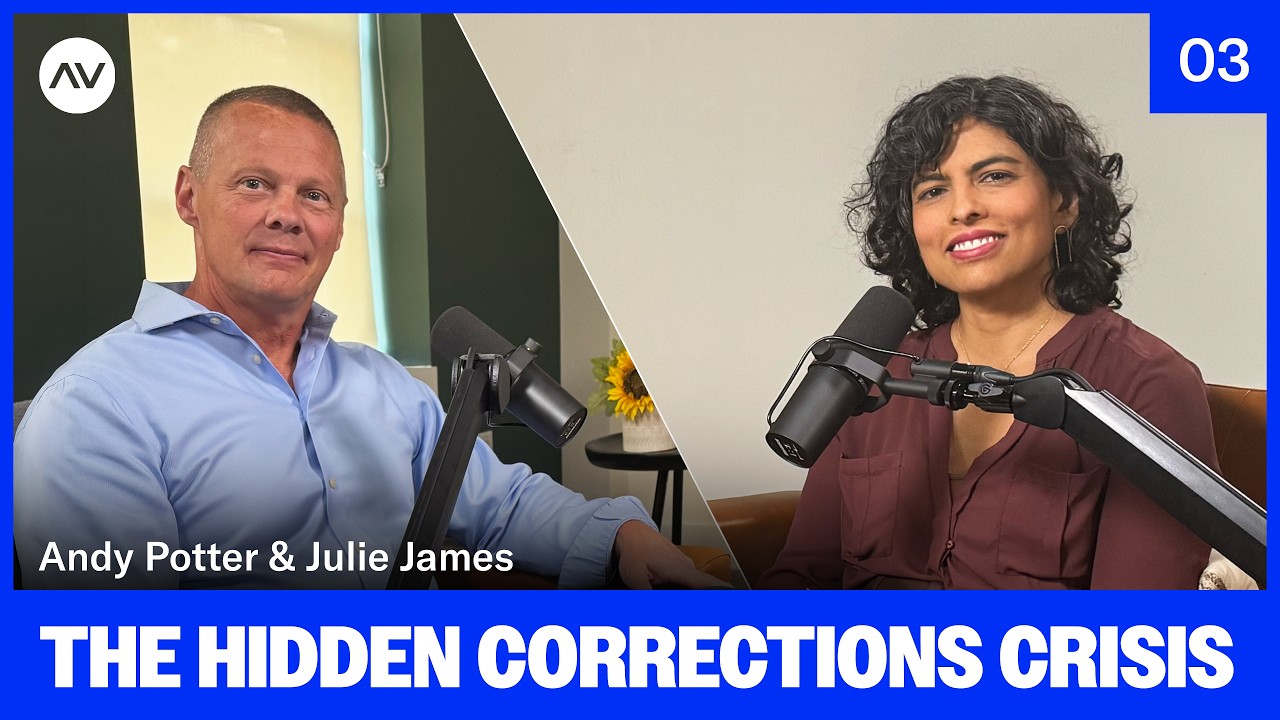
Julie James: One of the hardest challenges in the corrections system is staffing America’s prisons. Recruitment is down, keeping staff is difficult, and facilities across the country are looking for answers. Yet, it’s an issue the public knows very little about. Andy Potter spent 30 years as a corrections officer before founding One Voice United, an organization that represents corrections staff in criminal justice conversations.
In this episode, we talk about what’s driving the staffing shortage, what it means for the people working inside prisons, and what he thinks needs to change. He argues that this is more than a prison HR problem. It’s really a public safety crisis, and more people need to be aware of it. I’m Julie James, and this is Field Notes.
Thanks for joining me, Andy.
Andy Potter: I’m glad to be here.
Julie James: Well, I’m gonna start with your story. You worked in corrections for over 30 years. Can you give us an idea of what it was like to be a corrections officer?
Andy Potter: When you first hire in, you hire in ’cause you’re hoping maybe you can make a difference, maybe you can get into the middle class, and then you go into your training process, and things probably aren’t exactly what you would expect because everything you think about a prison isn’t always exactly correct.
Because you go in with a perspective of what you hear in the media, what you see on TV, things like that. So when–
Julie James: So what was your expectation when you walked in?
Andy Potter: So my expectation of walking in would be mostly people behind doors, behind bars. You had some autonomy to be able to talk and maybe coach somebody, maybe mentor, maybe get somebody thinking a little differently.
And, you know, by the time you go through the training, which is a [00:02:00] paramilitary structure training, and you go into the prison, your perspective has changed.
Julie James: Can you say more about the paramilitary structure? What, what does that look like?
Andy Potter: Yeah. So the… when you come into the academies and you start to go through your training, most of it is about how you restrain, how you apply restraints, you don’t trust anybody.
The paramilitary structure is mostly, we’re gonna tell you what to do. You’re gonna learn policy, and you’re gonna just do it. There’s no leadership development. There’s no innovation training. There’s no nothing that helps you to be able to cope much better with people. You might get a few hours of how you identify someone that may be suffering with mental illness.
But you don’t, you certainly don’t get trained in how to cope in that moment or how to, you know, process that person in a way that’s safe and healthy. You’re mostly about custody and security, and how do you maintain that in this environment? Anybody that says they’re not gonna change has never worked in a prison, ’cause you will be different.
It desensitizes you, and it programs you a little bit. Your personality and everything will change, and it takes away your vulnerability. You can’t be vulnerable. There’s no space for that, and there’s no space for weakness.
Julie James: Yeah, and I’ve heard the stories of the folks that participate in your convenings.
They talk about the profound change on them, you know, and the differences between being a civilian and being an officer, the impact on their families. Can you talk about what it takes for a person to walk through those doors and, you know, survive or even, you know, thrive in that environment?
Andy Potter: Yeah, it takes you to, as I said, shed away that vulnerability. You have to become… Well, you’re, you’re hypervigilant. You… That all kind of takes place in a matter of time. It’s kind of like the frog in the water that slowly warms up. It’s kind of like that, where you’re a part of a system, and the design of the system really is us versus them.
It’s really us versus them with the administration and the line staff and it’s us versus them with those that are incarcerated. So you really have to rely on your fellow officers and your fellow workforce members. But there is that… So you become a cohort in a team, and so there is that aspect to it, but it’s not as healthy as you would hope it would be.
You come in knowing that it may rely on your relationship with the next person on how you come out. And so there is… It’s an intense situation, but it’s not like people think. I wasn’t threatened every day of my life going in there by someone who was incarcerated. My frustration mostly was how the profession was being devalued, and so you go home, there’s no finished product for a lot of folks that work there.
You don’t get to be a part of the success. You don’t get to be a part or play a role in that. So when someone leaves, I may know them really well, and I may say they absolutely deserve to go home or vice versa. I may say, “I don’t know why they’re letting this guy out,” but–
Julie James: And you’re talking about incarcerated people–
Andy Potter: Yeah, when they get to go-
Julie James: like you don’t have a stake in their outcomes.
Andy Potter: Yeah, I don’t get to say, “I’m so glad you’re going home, and I hope you don’t come back,” and it’s not like that. I just know, are they gonna come back? And when they come back, as an officer, if you have had a relationship with them, you really are disappointed.
You’re like, ’cause you don’t wanna see someone come home. So when you go home at night, there’s no stories of success. There’s no finished product. It isn’t like something where I get to celebrate, and when I come back the next day, it isn’t like I hated my job, though. I liked my job. It was a humble living.
It provided my family and I a humble living. But I didn’t… I came back for what it was gonna allow me to do when I wasn’t there, not for what I was doing when I was there.
Julie James: So I’ve heard from others, and I’m hearing from you, that in large part it was about, you know, being able to earn a living, support a family.
You might have gone in with aspirations to help people, but that kinda quickly disappeared.
Andy Potter: Yeah.
Julie James: Yeah.
Andy Potter: Yeah, that kinda goes away, and now it’s even harder because of the staffing levels, and people have… There’s this narrative… In America especially, we’re fascinated with law enforcement for the wrong reasons.
You turn on the TV and you’re gonna find four channels, five channels where mostly what you’re gonna see is someone with a shield, somebody getting gassed, somebody getting dragged, this, that or the other thing. You don’t get to see the success. You don’t get to see the things that, that might wanna make someone go into that environment and that’s not, that stuff doesn’t happen every day, but that’s the narrative.
And so a lot of what made me keep coming back was the thought that I was making a good living for my family. It was middle class wages. And a lot of people that go into this work just wanna make a difference. So you’re, you have that hope that you are making some difference, that you are a part of something bigger that’s protecting the community, and so you have that pride in you about that.
But that’s not as prevalent anymore.
Julie James: Yeah. I mean, it’s gotten harder. So you mentioned the staffing issues. Tell me more about that, and why should people be worrying about staffing in prisons?
Andy Potter: The biggest reason we should worry is because it didn’t just start overnight. We’re hearing about it now, but it’s a crisis across the United States and that started a while back.
Public sector work has just been devalued and diminished, and especially in this kind of work, I think, because mostly people say, “Well, yeah, it’s a prison. You knew what you were getting into, so go do it,” right? “And stop complaining.” And that hasn’t helped whatsoever. The other part is the diminishing of the risk versus reward.
There’s a much different risk now than there was 20 years ago, for sure. The risk is you don’t have nearly the number of staff that come in, and the quality of staff isn’t the same. Their mission is not, does not seem to be as clear as it once was, and so that makes everything unsafe and it makes everything unstable, and you have programs that don’t run the way they’re supposed to run, and most anybody, any good officer that goes to work every day or anybody in there, whether it’s a nurse, it doesn’t matter, they want programs.
Programs are healthy, and you get to see somebody actually succeed and go home, when there’s programs, and they get to feel like there’s something worthwhile for them.
Julie James: Yeah.
Andy Potter: The problem is they never did that for the workforce. So they moved so quickly into giving incentive, into giving, into making programs and designing things, policies and things, that they left out the largest, the second largest stakeholder.
Well, that’s the workforce, and they never included them, and they never… So the incentives have just moved in a different direction. So the risk versus reward that I was talking about, is not, it isn’t there.
Julie James: Can you give us a sense of how bad it is out there?
Andy Potter: It’s bad. It’s like, I think in New York, they were doing 24-hour shifts at one point, and you can imagine when you’re deprived of sleep, everybody knows what sleep deprivation does.
It clouds your mind. It clouds your judgment. Makes you more lethargic, not on your toes, those kinds of things. And in many states that I talk to, they’re running, you know, several 16-hour shifts for sure, and back to back, and that’s forced overtime, right? So there’s a difference between when you voluntarily stay in an environment where you are locked in with everybody else and when you can actually decide your shift is over, I get to go home.
I get, I have a birthday party to… My nephew quit. He had five years in the system, and he liked his job, but the amount of overtime that was mandated on him allowed him to save some money- But it, but his value on his time is much different than it used to be. When I was, when I first hired in, I was like, “I want as much overtime as I can get,” and I, and we were mandated a lot, but not like they are today.
When I see him today and I see his physical and his mental stability has declined so much, it really made me stop and think on whether or not I would wanna encourage a relative to go to work in this line of duty. Like, you know, the environments and the conditions. The con- like, when it’s 90 degrees out, I bet you right here in Louisiana, I bet you there’s prisons where it’s 110.
I’d just bet anything, right? And you’re working in that as well as someone’s living in that, which is, you know, you can imagine the tension level there.
Julie James: And just to play devil’s advocate, a skeptic might say, you know, great, your nephew made the choice to leave the profession. That’s what people do.
They, you know, they vote with their feet. But why should sort of anyone in the public care? You know, this is, people can choose to leave their jobs. What should the rest of the public know about what the staffing crisis means for them?
Andy Potter: Well, when you have a turnover rate of 43% or better for anybody that has two years in or less, it’s more than just a workforce issue.
It’s about community safety. It’s about public safety. Like, as I said earlier, the, things happen when you don’t have the right number of people that come in to be able to operate the daily operations and the programming and the school and the healthcare, and folks are coming home from those situations.
They are gonna be let loose to come back into our communities and we should care about what’s happening while they’re in the prison system or in the criminal justice system as a whole. We should make sure that they do have the right kinds of tools when they come out to be successful. That’s a direct security issue for any community anywhere in the United States.
So there, there’s a lot that goes into why it’s important to have a good, healthy workforce. That gives you a direct line of understanding that people miss, ’cause they think it’s behind a wall, it’s behind a fence. I don’t wanna know and I don’t wanna hear about it. Just go to… Just make sure, you know.
But when you don’t have enough people to operate that, at some point, that line shuts down.
Julie James: Well, and I think that’s what, what people miss, is that most people are coming home, not to mention the officers, right, to their families, but certainly the people who are incarcerated are coming home.
They’re gonna be in the grocery store, they’re gonna be your neighbor, and how are we preparing them?
Andy Potter: When you think about change, and you think about what we expect out of someone who goes to work as a corrections officer or as a teacher or as a nurse or a program manager inside of a prison. Think about what that means for them when they come home and what their family is contending with as well.
There is such a ripple effect to this kind of situation where when people come to work and go home and they’re this unhealthy because of what’s placed on them by a system, it has a huge ripple effect.
Julie James: Yeah. So you saw this in the field, you saw this happening to colleagues across the country, and you decided to start One Voice United.
Can you tell us more about what motivated you to start?
Andy Potter: Two things really made me wanna do this. I was… I worked my way up through the union aspect. I became the executive director, Michigan Corrections Organization. There was a two-year time period, two, two and a half years, where we had 20 people commit suicide, people that I grew up with in the system, people that I knew from my own hometown.
And, you know, when you go to funerals where that’s the situation and everybody kinda knows what led up to it and everybody knows what one of the biggest symptoms are, and you have family members ask you not to let this go unchecked, it puts something inside of you. On top of, we had a riot in 2015, where we had a private food vendor bringing in food that was very subpar.
It wasn’t meant for anybody to eat. The officers knew it. Those incarcerated knew it. And so a lot of my, a lot of my workforce were taking pictures of it, which could have cost them their job But there was a moral aspect unfolding here where I actually saw humanity playing out where I had not seen that quite like this, where officers were saying, “It’s wrong.
They shouldn’t be feeding these guys this kind of food. Number one, it’s a safety risk for us, too. And number two, we eat it as well.” So there again, you’re inextricably linked. And so there was a riot, and it wasn’t just that food, but it was they raised the prices in the store, and they reduced the pay that people were…
So there was a perfect storm brewing, but not one officer was physically harmed. And I interviewed every single officer, I think personally, and I got transcripts to prove this. But all of them collectively were like, “We were told, basically, this isn’t about you guys. You guys were our advocates, basically.”
And that meant something. I mean, physically, they weren’t harmed. Mentally, there was a lot of harm done. No doubt.I don’t wanna take away from that because that’s as bad as being physically harmed sometimes. But they really pushed me, “Don’t let this go.” Like, this has to be a national thing that’s talked about.
Then I started to understand there were so many places where we were inextricably linked. And as a leader, as a union leader, I just did a very poor job bringing my members to the table so they could have a seat at the table so that they could help shape some of those policies that I think are dangerous, instead of just trying to resist it and being a road bump eventually ’cause it happens whether we want it to or not.
And so I saw these places like the food, like the heat, the conditions, and the staffing levels And the overcrowding. When you got eight people living in a cube that’s built for four and you have one officer, the ratios are a tricky thing. The officer-to-inmate ratios are very tricky, right? And a lot of legislators and others are misled because when you say, “Well, we have a five to one ratio,” or, “We have, you know, we have 200 officers coming in and there’s 1,000 incarcerated,” they’re not taking into account that gets broken up into three shifts, that gets broken up into transportation around hospital.
All these different things in the operation aren’t brought into the equation, so at any given point there might be two of us, and most of my days were like this, two, two officers for 240 inmates. That’s not… How am I possibly gonna provide protection, provide any kind of assistance they might need?
They’re almost insurmountable. You’ll have a lot… The staffing is so bad that I have office… I know a guy that just retired that said, “You know what? I’d have stayed. I liked my job, but I can’t be here twi- I know more about what’s going on with the guys in my unit than I do my own kids.” Now, when you know more about the, what’s going on in their life than you do your own family I’d say that’s detrimental.
I’d say that’s a crisis for a workforce.
Julie James: It’s not sustainable.
Andy Potter: It’s not sustainable.
Julie James: And the information that you all have, and the voice that you bring to it, and that’s, you know, in the name for a reason, right? You know, you can help legislators understand better what the impacts are, but you weren’t given a seat at the table, wanted to give kind of a platform for these concerns, as I understand it, right?
Andy Potter: Yeah. We’re not given a platform, or if it’s… I can’t just have an officer or someone from the workforce just talk to a legislator, ’cause then they gotta write a memo saying that they talked to a legislator, and they gotta say what they talked about. I can’t have them talk to the media because that’s a violation, and they can be fired for doing it.
So it’s limited to who’s able to really talk about this and really raise that voice up. That’s one of the beautiful things about One Voice United. It is… It does give a national platform for those working inside of those prisons and jails, whether it be an officer, a maintenance man, a teacher, do- it doesn’t matter who it is, we bring all those professions together to raise up those concerns and to also raise up what’s positive and what’s great.
Julie James: Well, so let’s go there. Yeah. Like, what is working? What are you hearing that makes you optimistic?
Andy Potter: What I’m hearing is the willingness for people to listen. I love the fact that you have legislators that are calling me and calling others and saying, “I just wanna know, like, what is going on, and what do I need to know to help?”
And when I see places, and it might be just pockets, but it feels like the needle is moving when I see places, like Little Scandinavia is just one place that I’ll talk about. Because when I talk to the officers who work in there, and I talk to the program people that work in there, they feel like they have some autonomy.
Like, they really feel like they’re a part of something bigger, and they get to play a different kind of role. And when you have a warden or a director who’s listening to those lines, to that workforce and those officers and others, and they’re considering them to be the true consultants, when they’re considering them to be the professionals that they should be conferring with about whether they should tweak something or whether they should do…
That is a, for me, that’s w- that’s exactly part of a solution to what’s going on. You know, early on with One Voice had the opportunity to be exposed to a lot of things. Not just one in particular, but I was able to go and experience different systems from Scandinavian countries, and it blew me away. It really, like, this is where I started to think…
Where I really failed as a leader bringing people to a place to help shape what could be. Instead, you get stuck in that frame of mind that, that paramilitary structure where you’re just told you’re gonna just do what you’re told to do and don’t violate something or you’re gonna be wrote up. Instead, there was a place where I saw everybody that worked there being a part of a team for success.
That’s the way they were trained. They had two years of college education, and the staff ratios there were triple what they are in the United States.
Julie James: Well, that seems to be a real roadblock, right? I mean, you know, some of the… What you’ll hear is, you know, we’re not Norway in so many ways, right?
Like our demographics, the educational requirements. Right now, we’re reducing the education requirements. We’re reducing the minimum age for- for officers. But something happened there, right? I mean, it, what can be adapted from those places?
Andy Potter: So number one, it’s how someone comes into this workforce and their intentions of coming into this workforce have to be spearheaded by those that are hiring them.
Like, they have to be hired, and they have to be brought in with some intention. And that seems to be changing, too, which is another positive, and that is because we’ve been exploring these other models. And then when I took leaders there from unions and, of all different sorts from around the United States, and the reason I took them was not to convince them that the Norway model is the perfect model and that it’s gonna work, ’cause we have our arguments on why it won’t.
I wanted to bend their minds differently around why some of it could work and why was some of that important, and I wanted them to meet with their counterparts, which were union leaders, so that they, those union leaders could instill in them that we helped build this. We helped shape what this looks like.
And in that, it set a legacy effect, which is different than a culture change, by the way. You can’t get a culture change unless you have a legacy change where… Like, I helped, I helped write policies on MRSA and bloodborne pathogen and different things because my director allowed me a seat at the table.
And when I helped create that, those policies still are today.
Julie James: So sustainable change, it’s, for you it’s, it was about the process, who’s at the table, and in some ways, what I’m hearing, is empowering people to have new ideas–
Andy Potter: Yeah…
Julie James: for answering the problems that exist.
Andy Potter: And help teach leadership, because you have…
It’s sometimes to stand out and to do something different, is a risk when you’re a leader. It’s a risk when you’re a director.
Julie James: Shifting gears and zooming out a little bit, what have you seen here work as a way to engage people and to make change happen? What’s been successful so far, and what would you like to see more of?
Andy Potter: I do see that, you know, that technology is starting to play a bigger role. That might play into some relief when it comes to how the prisons are staffed. That’s another area that I think should be explored even more. I think we should help innovate. I think the professions that work in there, the different professions that work in there, should be brought as a consultant into this, and so that we can rethink the entire system.
Currently, so we can’t just have miraculously another system that’s great. We have to also operate inside of the one we have now, and that means bringing those, all those stakeholders together so that they can play a role in that. I just think technology could play a bigger role. I’m not afraid of technology inside of a system like this if it’s built in a way that it complements those that are working in there.
Julie James: So speaking about the people, one of the big aspects of the work that you do with One Voice United is bring people together, in-person convenings. How valuable are they for bringing about change? What would you say about the–
Andy Potter: I can tell you some success just from the work that we’ve done bringing together the most unlikely partners.
For instance, a union leader who’s supposed to be a big obstacle here, bring them together with someone who’s formerly incarcerated so they can share in peeling back the layers of the systems they work in, and they can see where they are very inextricably linked and where it makes total sense where they should come together.
If they really wanna change that system the way they talk and have that evolve into like a program that allows somebody who’s in a jail to work on a tablet, and when they, when they stumble in, they get into trouble, they’re not just kicked out of the program. The program gets to follow them, and they get to continue to work on their tablet.
Now, that is something that was brought together by someone who was formerly incarcerated and someone who is actively working inside of the prison to make something better for the staff and for that person that might have just been kicked out of a program because they got into trouble, and they’re gonna max out and go home.
So why would you not want that program to follow them through to give them the best opportunity to not come back? But that happens inside of the group that I’m bringing together.
Julie James: Yeah. So the convenings, it sounds like they’re incredible for bubbling up innovative ideas, for developing collaborations.
I also have seen incredible emotional outpourings, like people talking about the impact that it’s had on them and their families. You’re providing a space of healing, if I may say.
Andy Potter: Yeah. That’s our hallmark is wellness, because we believe that’s where it begins and ends, is really how you bring people in healthy enough to where when they go home, they’re in a good state of mind, and then how they come back.
And if you can fuse that inside of your expectations or what someone has to do in a day, or if you can fuse that, you’re gonna do a lot when it comes to people staying in that job and wanting to do that job. And so the retention, the most important thing we struggle with right now is the retention.
And if you can meet someone where they’re at and help them to stay mentally, physically healthy, and they can come in and feel like they’re appreciated, like they’re a part of a team. And they get to go home feeling like, like they were a part of something bigger. That’s a, there’s a recipe there, and there’s a lot missing in that recipe nowadays.
Julie James: So some might perceive corrections, unions, and officers as being, you know, opposed to any changes, right? That that’s kind of the natural reaction. I’m curious, is that… do you see that as accurate? And then second, if so, are there any signs of change?
Andy Potter: Yeah, I think it is accurate. There is a lot of resistance.
As I said, I myself didn’t do a great job of approaching it from a non-tactical point of view. Mostly, unions wanna, if there’s change, they wanna push back on that change to make sure that the employees are safe, for instance, and if part of a policy doesn’t provide that safety, they’re gonna push back on it.
And when you even say the word reform, a lot of unions and a lot of correctional officers, right away, they’ll bristle because it’s never been about them. Like I said, they’re the second largest stakeholder, but if you’re gonna reform an entire system this big, it seems as though you would want the second largest stakeholder, the one you’re asking to perform and do the changes that you’re asking, to be a part of that.
The problem we have is there’s changes made, and then people try to convince the workforce that it’s gonna help you too, instead of having them at the table. So there’s a lot of unions that will just resist because they’re not brought to the table as a player. They don’t have a stake in it. They don’t… their members aren’t looked at in the equation as being a part of what we need to save, what we need to protect, what we need to help.
They’re looked at as a workforce, and you’re gonna do it because that’s our system, and you’re… and which also pits those employees against those incarcerated.
Julie James: Are you seeing any signs of change?
Andy Potter: I am seeing some signs of change because I believe we’ve been able to work with a lot of union leaders who also now start to understand how they should be engaging differently when it comes to some of these policies, how they should be informing them differently.
Instead of just resisting, they’re starting to wanna become a player and become a stakeholder, and it’s allowing some managers in certain pockets to allow them to have some autonomy, to be able to do those kinds of things without being micromanaged into that paramilitary structure. So I do see things changing.
I do see that their voices are being heard more and more in the media and otherwise. I… Wellness for staff wouldn’t… 15 years ago, you wouldn’t even be talking about it, and it’s because we have put those voices together and really brought it to a national attention that it’s now being looked at.
So I see a lot of positive going on. Not nearly enough and not nearly fast enough for all of us, but it’s a big system that’s taken a long time to get here. We just need to do more when it comes to the incentive of why you should wanna work there, why you should be a part of this. The why is the hardest answer for anybody.
Just money isn’t it. There has to be something more, especially with this new generation. We need different work shifts. We need different… Like, the way we approach the work has to be different, and you need to train them for the work you’re expecting them to do, which is much different kind of training.
There’s dynamic security, and there’s all kinds of, you know, emotional intelligence training. And give them a further education. Give them an opportunity to grow and expand their leadership. Do leadership development to where they feel like there’s an innovative process where I can actually come up with ideas that matter, and listen to me.
Don’t just treat me like I’m just, you know, a cog, ’cause that’s what I’ll become, and that’s what’s happened. And that’s one of the reasons people don’t wanna stay in this work. They don’t feel valued.
Julie James: So if a young person came to you today and said, “I’m thinking about becoming a corrections officer,” what would you say to them?
Andy Potter: It’s not the same answer as I would’ve given even just a few years ago probably. I don’t know in my right mind I could consciously tell someone you ought to do it. I don’t know bringing them into the system as it is, is not a healthy system. It wasn’t a system designed to be healthy, and we’ve got a long way to go to make that system much healthier than what it is.
But to bring somebody else into this that’s young, knowing the trauma that it’s placed on a lot of people I know, including myself, I carry my own share of trauma still to this day. I don’t know. I would tell them, “Try to learn as much as you can. Try to play a role in making change. Don’t ever give up.
Don’t ever stop trying to make the system better than what it is.” If it’s something you’re gonna come into, come into it with an understanding that if you feel like you’re starting to change and your family feels like you’re starting to change, don’t stay. The risk versus reward is not what it once was.
Pensions aren’t nearly… A lot of states don’t have pensions. A lot of states don’t even have healthcare. And you, your body goes through a lot. I’ve had surgery after surgery because of what my body’s been through working in this system, and I couldn’t imagine not having healthcare for me and my family.
Like, those are incentives. Those are things that matter. Those are things that people come into this workforce ’cause they didn’t have growing up, perhaps. And so when you take all those away, that risk versus reward, well, great, I made a bunch of money ’cause I was forced into working overtime, and I didn’t get my son’s birthday in.
I wasn’t able to go to my daughter’s volleyball game, and my anniversary was me working here. There’s no… And that’s it, because you’re making money, but you’re not… That’s not providing the way I provided for my family. I provided healthcare, I provided a pension, something to look forward to at the end of it, where I could say it was worth it.
Julie James: Yeah. Something’s gotta give, though, because the situation as it is, we’re in crisis mode, and I know leaders are desperate. They’re trying a whole bunch of things that we’re eager to partner with them on and evaluate. You know, your organization is helping encourage a lot of those reforms.
So, there’s a glimmer of optimism that I have about the future, but I hear you. I know we’ve go- both got teenagers, and what I’m hearing you say is maybe not. Maybe not the life of a corrections officer today as it is.
Andy Potter: Yeah, maybe not, and it’s not just in our country, it’s other countries now, too.
Even in Scandinavian countries are struggling with the staffing. And, you know, I still see those glimmers of hope, though. I still see that people wanna change, they wanna try things. One of our biggest problems is we don’t do enough to support and to back folks that are taking those risks. We have a lot of correctional leaders that are directors, commissioners, and wardens and others that are trying to do some stuff.
Number one, we gotta back ‘em. When it doesn’t work, then we gotta recognize it, and we gotta try it again. They need to involve the workforce as a consultant, and we gotta make sure that they have that ability to make some mistakes along the way without just saying, “Okay, well, we need a new director now because you’ve tried something, it didn’t work.”
And so that’s how we treat the directors, too? That’s how we treat… The entire workforce is affected. When you don’t have consistency, when you don’t have people who know the system that are able to try things, yep, it ain’t always gonna work, but the fact that they’re trying and they really do want to make some success happen, they just need to include that workforce.
They need to bring them to the table so that they have a stake in this, and we need to support them, and we need to back them, too, and we don’t do enough of that.
Julie James: Yeah. Well, that’s an important message for legislators to hear, for people in positions of influence. Is there anything else you’d add that you want them to hear?
Andy Potter: Yeah. If we wanna really take a look at how you bring people into this employment, then you have to do something with that risk versus reward, like I said. And yep, it is gonna be expensive. But where are we at right now with this and where we’re going, it’s gonna be a lot more expensive down the road.
We have a lot of infrastructure that needs to be replaced, that gets overlooked, which creates a horrible environment to live in and to work in, and people aren’t gonna wanna come in there, where the tiles are chipping up, and the… and there’s no air conditioning, and the water is horrible, and on and on and on and on, and I could go on and on.
Think about how old our prison system is. Come on.
Julie James: Yeah. We’ve got our work cut out for us.
Andy Potter: For sure.
Julie James: Andy, thank you so much for the fantastic conversation. That’s all we have time for today. If people wanna find out more about One Voice United, where should they go?
Andy Potter: www.onevoiceunited.org.
Julie James: Perfect, and that’ll have everything that they need.
That’s all from us this week. Thank you for listening or watching. Please do subscribe for more conversations, and we’ll be back soon. Goodbye.