Communities and policymakers across the country are prioritizing public safety and strengthening their criminal justice systems. However, many proposed interventions and reforms lack a foundation in rigorous research and reliable data.
For more than a year, Arnold Ventures (AV) has been addressing this problem by hosting a series of convenings that bring together researchers and practitioners across a wide range of criminal justice topics. These BRIDGE Days — short for Building Research Ideas and Generating Evidence — are designed to spark communication and collaboration between people and organizations who too often operate separately.
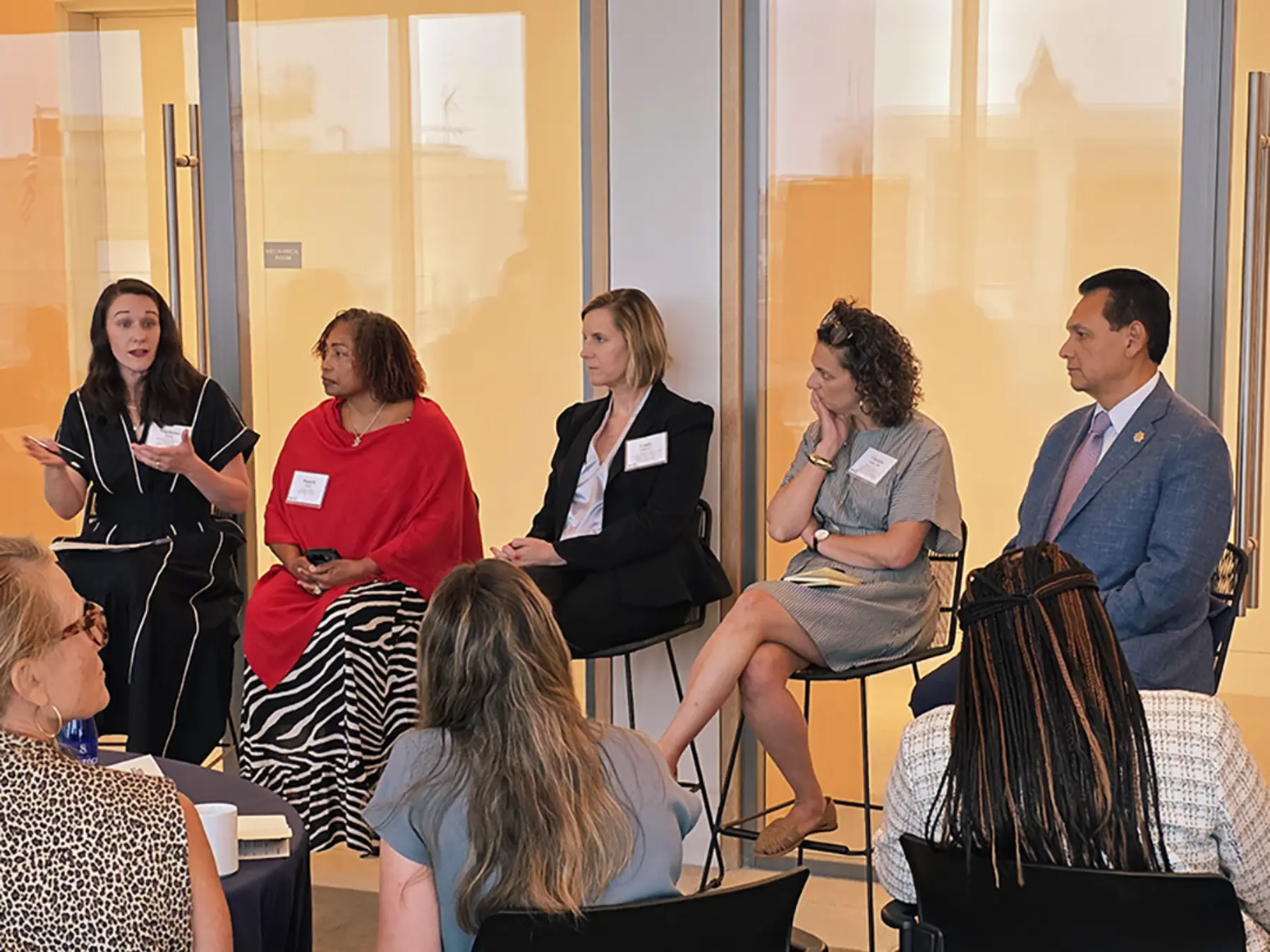
BRIDGE Days strengthen researchers’ and practitioners’ networks, prompt them to think strategically about the most pressing problems in criminal justice, and invite new partnerships and collaborations. “Nothing can replace the convening of brilliance in a room,” says Sergio Rodriguez Camarena, criminal justice research manager at AV and one of the lead organizers of the BRIDGE Day event series. “These events are a really good sounding board where criminal justice experts and researchers are all together, sharing and testing new ideas.”
In 2025, AV hosted a total of 23 BRIDGE Days, covering crucial public safety topics such as jail churn, electronic monitoring, overcrowding in correctional facilities, nonfatal shootings, women in the justice system, and justice-involved veterans.
The events have been widely praised by participants and have led to several fruitful collaborations and new research projects. “What we have found is that BRIDGE Days are effective,” Camarena says. “In addition to building organic connections and deepening knowledge about the topic, attendees are submitting new research proposals to AV, which in the long run will help policymakers and communities understand better what works and doesn’t work in the criminal justice field.”
Gaining a broader perspective
Typically, BRIDGE Days include expert presentations and carefully structured group work sessions between practitioners and researchers.
At an August event focused on women in the criminal justice system, one participant was Sheriff Ed Gonzalez of Harris County, Texas. Gonzalez presented experience and data on the issue, drawing from his leadership of the Harris County Jail, which is one the largest in the country, as well as his role as a member of the Council on Criminal Justice’s (CCJ’s) Women’s Justice Commission.
Gonzalez’s panel presentation led to conversations with researchers about potential projects. One thing that came up, Gonzalez says, was the lack of data on women in jails. New research projects could help tease out the impacts of incarceration on children, the effects of visitation, or best practices for women who are pregnant while incarcerated. “I think there’s a lot of data that’s ripe for mining,” he says. “I lead the largest sheriff’s office in Texas and the third largest in America, and being able to connect with researchers in that space who are looking for opportunities is valuable, because we are able to find potential areas for collaboration.”
Gonzalez has become something of a frequent flyer at the BRIDGE Days, also joining one in June on jail churn and disorder and one in August on addressing nonfatal shootings. His repeat attendances are testament to how much he values the chance to network with colleagues across the country to learn about best practices.
“As a police executive, it’s important to gain a broader perspective, to make the best decisions and help shape not only my profession but also the corrections and law enforcement functions that I lead,” Gonzalez says. “The BRIDGE Days were incredibly insightful and impactful.”
Another BRIDGE Day held in October focused on justice-involved veterans. One presenter was retired Brigadier General David “Mac” MacEwen, who brought deep expertise in leadership, veterans’ issues, and systems-level reform from his distinguished Army career and his current work with CCJ’s Veterans Justice Commission.
One problem, says MacEwen, is that there is little reliable information on how many veterans are incarcerated or who they are, which therefore challenges the delivery of the services they need to transition back to society successfully. Moreover, the military justice system lacks important options available in the civilian system, such as drug courts and other therapeutic interventions.
“We need evidence-based practices, we need research, so that we start looking at these issues through the lens of what does and doesn’t work,” MacEwen says. “We want to make decisions based on facts, not based on gut.” During his panel presentation, he outlined a few key recommendations from the CCJ commission, including improving services and creating alternatives to incarceration for justice-involved veterans.
Working with researchers during the BRIDGE Day highlighted both the barriers to accessing useful data and some possibilities for getting around those barriers. In particular, MacEwen was impressed by the ideas of Jeff Wenger, a senior economist at the RAND Corporation. Wenger discussed possibilities for conducting a longitudinal study on incarcerated veterans, gathering data directly from veterans instead of relying on the Department of Defense, the Veterans Administration, or other bureaucracies.
MacEwen says that this kind of long-term research is badly needed, and he hopes that researcher-practitioner partnerships coming out of the BRIDGE Day can help to spur it forward.
“If you want to do it right, you have to have that long-term vision, and that’s what I was impressed with,” MacEwen says. “There were people in that room who really wanted to fund and carry out that long-term research. The whole group was very thoughtful.”
The ongoing crisis in the corrections system was the topic of another high-impact BRIDGE Day held in May. One participant was Dr. Shaneva D. McReynolds, president of FAMM, who has spent her career championing a justice system grounded in accountability, human dignity, and community safety. McReynolds’ advocacy is deeply informed by lived experience, and she is a part of the Safer Prisons Safer Communities campaign, which brings together corrections professionals and incarcerated people to address issues of understaffing, overcrowding, and poor conditions in U.S. prisons.
During the event, participants discussed the many problems that arise from the corrections crisis. Small-group discussions brought together uncommon partners — prison administrators, advocates, faith leaders, and nonpartisan groups like FAMM — to consider solutions.
“Far too often, we find ourselves in a room with allies, and we end up preaching to the choir. But you don’t get anything done that way,” McReynolds says. “The outcome of the conversation was that individuals in my group who I would not have ordinarily thought to work with walked away talking about working together to establish new relationships and better means of accountability in corrections.”
“You cannot refute data”
The BRIDGE Days in 2025 led to many exciting new collaborations and research proposal submissions that will contribute important causal research to the criminal justice field. AV aims to replicate these outcomes in 2026 with a packed roster of BRIDGE Days, including topics like community violence intervention programs, prison innovation, police officer retention strategies, and effective interventions for domestic violence offenders, among others.
For her part, McReynolds left the BRIDGE Day on the corrections crisis with new contacts and relationships, she says. She also brought ideas back to the research department at FAMM, with the intention of starting new projects on topics like measuring the ratio of corrections officers to people in custody across states, to help understand where change is needed.
“As a researcher, I always say, you cannot refute data,” McReynolds says. “Research is key, because numbers do not lie, and when you couple empiricism with lived experience and present that to decision makers, you can start to address problems.”