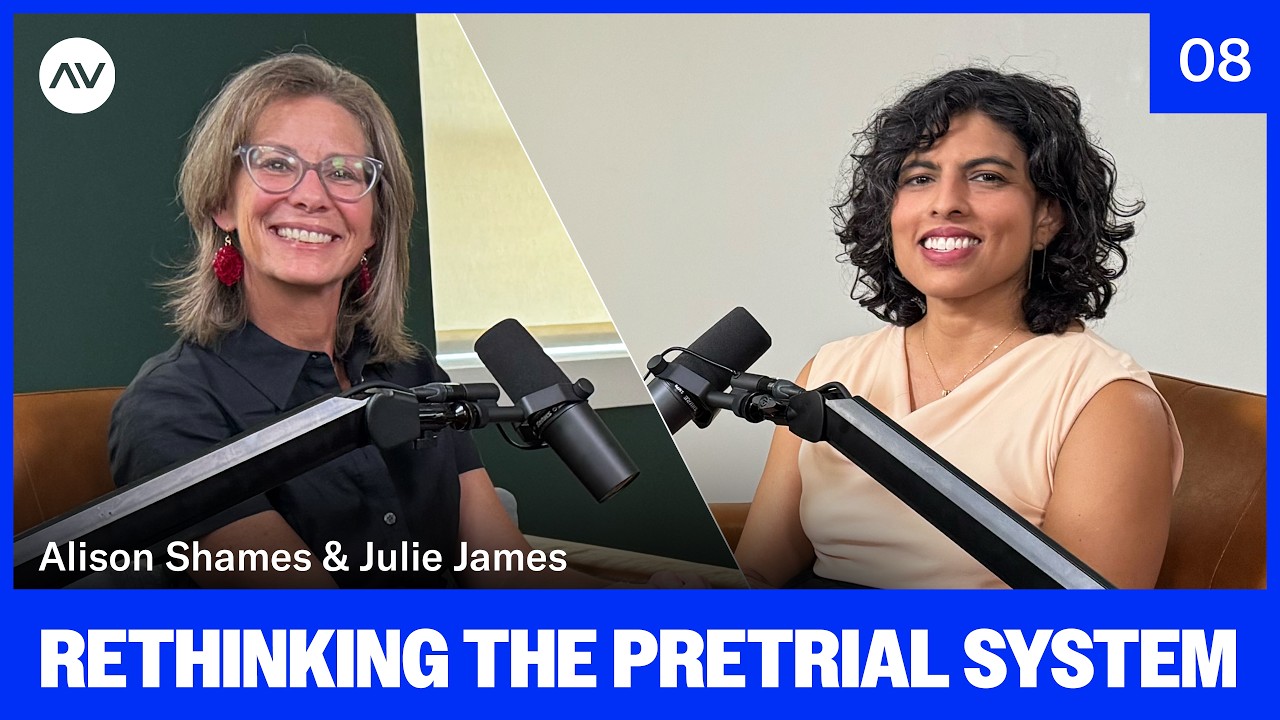
[00:00:00] Julie James: The American pretrial system, the period between arrest and trial, affects millions of people every year. How it works and whether it’s working well is one of the most contested debates in criminal justice. Alison Shames is a director at the Center for Effective Public Policy, and she spent years working on pretrial reform.
In this episode, we talk about how the current system operates, what the evidence shows about its effectiveness, and what changes she believes could improve outcomes for public safety and the justice system alike. I’m Julie James, and this is Field Notes.
Thanks for joining me, Alison.
[00:00:55] Alison Shames: Thanks so much for having me, Julie.
[00:00:57] Julie James: So the pretrial system in America, or [00:01:00] systems, they can appear quite complicated. So can you give us an overview of that process and what you believe are some of its problems?
[00:01:08] Alison Shames: Yeah. I think that is probably one of the biggest problems in our country is that people don’t understand the pretrial system, yet it’s an area that is not working as well as it could.
The pretrial system is, generally speaking, the time after someone gets arrested and their case is disposed of in some way, whether that’s a guilty plea or trial, conviction or dismissal. But as it stands today, in most places, there are some exceptions, when someone is arrested, they are brought into custody, and they appear before the judge, usually within 24 to 48 hours, and at that very first hearing, the judge has to decide whether they’re gonna release that person to pending their trial or the end of the case, or whether that person is going to be detained.
Normally, these hearings are [00:02:00] very, very short, very, very quick, and more often than not, the judge is often just setting a money bond on that person, something that we call a financial condition of release. If the person has the money, they will be released. If they don’t have the money, they may be detained.
And then they may stay in jail for a day or three months, depending upon when or if they can make the bond and when the case is resolved, whether that’s by trial or plea agreement or dismissal, which often happens.
[00:02:32] Julie James: So help us understand what that’s like for a person going through that.
[00:02:37] Alison Shames: What’s really important to remember when we talk about the pretrial phase is that in America, people are presumed innocent until proven guilty.
So there is a presumption of innocence, yet in our country, we are detaining and really punishing a lot of people before they are convicted of any crime. So that is a really [00:03:00] important principle, I think, that rules our pretrial system, but it’s not always happening in practice, right? Because of the use of money, which is one of the biggest challenges.
So imagine if you’re Someone who gets arrested, many of the people who are being arrested are lower income individuals in our country, and the judge puts, maybe they’re arrested for drug possession or trespassing or shoplifting, a lot of minor crimes. People think of crime and they think of violent crime.
Violent crime is not the majority of crimes that we see coming through our system, right? So most of these crimes are really lower level offenses that aren’t causing violence in the community. Nevertheless, people are being arrested, which if they’re breaking the law, they could be, coming in and a judge is deciding to set $1,000 bond, $10,000 bond, somewhat arbitrary.
But the reality for the people who are before that judge [00:04:00] is they have to choose to pay the rent, feed their children provide for their family or pay a monetary bond to get out of jail. And those are really real choices that people make. So I think that’s, I mean, that’s one of the biggest conflicts immediately when someone gets arrested.
[00:04:21] Julie James: So the work that you’re doing at Advancing Pretrial Policy and Research, and I know we call it APPR a lot for short, can you give folks an idea of what it is you’re trying to achieve with that initiative?
[00:04:31] Alison Shames: We’re going on our seventh year of APPR, thanks to Arnold Ventures, and it really is an initiative that it approaches the pretrial system through a number of different lenses.
So we see our role to, one, really help jurisdictions around the country to understand their systems and identify where they can make changes to improve their outcomes. We see our role as training pretrial professionals [00:05:00] around the country through conferences and webinars, really trying to help people understand best practices when it comes to the pretrial process.
And we also, we create a lot of resources that people can also read and use, very practical guides. And also really building a community for pretrial professionals. When you’re working in a jurisdiction, criminal law tends to be very county-focused or, so it’s very look local, locally based.
And people kind of exist in that vacuum. So what we have found really helpful for the field is developing communities where people can ask questions of each other and learn from the experiences from people around the country. So, that’s a lot of our work to bring these best practices to places, keeping in mind that the outcomes that we’re trying to achieve are ones of, that everyone in the system agrees to.
That is, we’re looking to keep the community safe, [00:06:00] and in the pretrial phase, the thing that they’re really looking to make sure happens is that the person appears in court, right? So if someone is released pending their trial, they need to come back to court for hearings before that case is resolved.
So those are really the two interests of the system during the pretrial phase: to keep the community safe, so trying to make sure that person isn’t rearrested during that pretrial period, and also making sure that they come back to court. That’s the purpose of the pretrial system. It is not to punish. It is not to teach anyone a lesson or to make an example of anybody.
Those are the two goals of the pretrial system. It’s what our kinda constitutional principles tell us to honor that presumption of innocence. The Supreme Court has told us in a number of cases that release is the norm. And detention really should be an exceptional case. It should be the exception, not the rule.
[00:06:59] Julie James: Right. So the [00:07:00] north star for these systems is safety and showing up for court, and the punishment comes later.
[00:07:06] Alison Shames: Absolutely. The jury decides, right? That’s a different phase. Once the person is convicted, then a judge need, has to decide, well, what’s the punishment? But in the pretrial phase, you’ve just been accused of a crime you haven’t been convicted.
So again, we have a presumption of innocence in our Constitution, and to honor that presumption of innocence, release is the norm. Now, in some cases, someone really could be a risk, that if that person was let out after that arrest, if there is a high likelihood based on… according to the judge and based on evidence that would be put in front of the judge, they can decide whether there’s a risk of that, whether there’s a risk that someone may be violent to someone else.
One of the most common offenses, violent cases that are coming through our courts these days is domestic violence. [00:08:00] Every time there’s a domestic violence case, you really… the judge is asking, “Is this person going to harm their partner?” So there are times where it is very appropriate to detain someone during the pretrial phase.
[00:08:13] Julie James: Well, this is obviously an issue that is… could be polarizing and yet jurisdictions across the country have to figure out what to do. And you talk to a lot of people from a lot of different… with a lot of different stripes all across the aisle. Perhaps you can give us some examples of people who might have changed their priors.
[00:08:33] Alison Shames: Yeah, I mean, I think looking at places that have changed their system is the best example, and we have that in New Jersey, Illinois, New Mexico. These are states that have completely changed their pretrial systems. They no longer use money, and in… so no financial conditions of release are being set, and instead at the pretrial hearings, a judge is making a very intentional, purposeful decision about whether [00:09:00] this person is a danger to society and whether they are a flight risk.
For decades, though, our system has used money, and so I’ll talk about Illinois specifically. They changed their system about two years ago. It was a statewide law, and on day one of that law going into effect, money was no longer used, and instead they, the judges and the courts were holding hearings to decide whether someone would be detained.
[00:09:27] Julie James: Based on safety.
[00:09:28] Alison Shames: Based on safety.
[00:09:29] Julie James: And appearance…
[00:09:30] Alison Shames: and whether they were a flight risk, right? Willful flight. Just a note about that, because appearance is something where if you don’t appear in court, a lot of people think, “Oh, they’re fleeing the jurisdiction.” That rarely happens, right? More often than not, someone forgets, right?
Just like we need reminders for our dentist appointments, reminders help people come to court. But really more often than not, people are forgetting.
[00:09:58] Julie James: And that… and there’s actually…
[00:09:58] Alison Shames: or they don’t have transportation…
[00:09:59] Julie James: [00:10:00] yes, a really strong research study that we’re really excited about that notifications work really well.
They’re really low cost, and they work really well to reduce failures to appear.
[00:10:10] Alison Shames: So when Illinois changed, it now is a system where someone is arrested, only certain crimes are eligible for detention, right? So very low-level offenses, you cannot detain that person pretrial. Instead, the judge would be deciding what release conditions they might wanna, want you to have.
That might be putting you onto pretrial services so that they can refer you to supportive services, making sure that you get reminders, and really just checking in with the person along the way and making sure they have the support to get back to court and get referred to services that might help them find a job or go into substance use treatment or something like that.
Not ordered by the court. The order of the court is just to check in with the person, but then pretrial services can help them stay out of trouble and return to court. If [00:11:00] the prosecutor wants to detain the person, they move to detain, and then the judge holds a detention hearing. Now, again, this is different.
In most places, outside of those three states, there’s just a hearing, a financial bond is put, the person is released or not.
[00:11:15] Julie James: Based on whether they can afford it, but not necessarily…
[00:11:18] Alison Shames: that’s all it is. It’s a wealth-based system for the most part. What that means, though, is that poor people might get stuck in jail, and people with the means, the financial means, even if they are a public safety risk, can get released.
That’s not a system that works for anyone, right? That is making our communities less safe, not more safe. But in a place like New Jersey and Illinois and New Mexico, and in some places, others, counties around the country, the judges are making more intentional decisions.
[00:11:52] Julie James: So you’ve mentioned Illinois, New Mexico, New Jersey.
These are… This is a blue state under a red state for New [00:12:00] Jersey in the case of Governor Christie. New Mexico, I think, is purple. So this is something that folks are doing because they know they need to have a better way of assessing whether someone should be released or detained, released under what conditions.
What kinds of arguments have you found to resonate?
[00:12:19] Alison Shames: New Jersey got interested in pretrial reform because of a study that was done in that state. And the study was done, and it revealed that nearly 1,000 people were held in the jails in New Jersey with bond that was, like, under less than $1,000, right?
So you have hundreds of people in jail Arrested on relatively low-level offenses, and they were sitting in the jail pending their trial because they couldn’t afford a $1,000 bond. That hit people on both the left and the right because why were they there? [00:13:00] Why was the state paying for them to be detained?
And why were those people not in their community spending time with their families, working, going to school? And so the state really wanted to examine that, and they ended up changing their system. And Governor Christie knew this because Governor Christie had been a US attorney in New Jersey, and the federal system doesn’t use money in this way.
They make intentional decisions about release and detention. And so New Jersey made that shift, and they said, “We do not want people in jail who don’t need to be there.” Right? They are better… It’s better for public safety for these people to be released. Studies, numerous studies, have shown that if people are detained pretrial, they are more at risk of getting rearrested after they are released and not returning to court.
Being in jail causes more crime. Now, again, some people need to be in jail if there really is a high [00:14:00] risk that they will be dangerous in the community. But for the most part, they don’t. And so New Jersey made that shift, and year after year of the data since 2016, I think, when it was implemented, there’s been no increase in crime.
Pretrial release has benefited a lot of people and the system is working great. People are still being detained, but they’re being detained after a judge makes an intentional, thoughtful decision about whether that person is at risk, right? Of, of a public safety risk. One other story from Illinois that I’ll mention.
There was a state’s attorney, their district… a district attorney in a county that was very against it. It was a state law. There were a lot of state’s attorneys not in favor of getting rid of money bond and the changes to the pretrial system. This was one of them. Now, after it went into effect, we talked to her and said, “Well, how’s it going?”
And she sort of grudgingly [00:15:00] conceded that it was going well, that it really wasn’t much different from how the system was working before, that the people she needed to be detained were being detained. What she said, though, was that it was taking more time. And I thought to myself and said to her directly, “Well, isn’t that a good thing, right?”
You are taking someone’s liberty away, the most sacred, really, right that we have in our country of being free and having your own liberty. We should take a little time to decide whether someone should be locked up or not. The other thing it does for the person who’s going through that system is it’s giving them a sense of fairness and justice.
It’s procedural justice, which is a well-known researched principle, that when someone does have that fairness, they actually believe in the system more. We do have in our country right now, a lot of people don’t trust the criminal justice system. They don’t think [00:16:00] it delivers good outcomes. So what I was hearing from the state’s attorney was that a change of this nature, not only did it still detain the people that needed to be detained and allowed those to be released who could be released, but it actually may be resulting in greater trust in the system by the people who are going through it.
Who doesn’t want those results?
[00:16:22] Julie James: Well, so you’ve talked about the risk-based approach and that that’s sort of underway in a lot of different places at this point. Can you tell us a little bit more about what goes into that? What does it look like on a practical level?
[00:16:36] Alison Shames: The biggest change for a jurisdiction that has to move to, that should move to a risk-based approach is understanding that money is not an effective condition.
Again, we have used money, you know, for hundreds of years really in this country, but more so in the [00:17:00] last few decades. And numerous research studies have shown that money is not effective at bringing people back to court. Many think it is. Many think, well, if you pay something, skin in the game or something, right?
And you might lose that money, right? That’s an incentive to return. But research… numerous research studies have shown that the return rates, the appearance rates for people remains the same. And the safety rates too… whether you put money down, and the safety rates never impact safety. Because you don’t even lose your money if you get rearrested, right?
So doesn’t even work as an incentive, but people think it does. Money has no connection to the outcomes that we want in pretrial.
[00:17:47] Julie James: So, what does? Tell us what, what goes into a good risk-based decision.
[00:17:51] Alison Shames: So the first thing is making sure that the judge makes that intentional decision to release or detain [00:18:00] someone, not let money decide.
One of the challenges there is not… not every system is set up to allow a state to do that. The laws need to be changed sometimes, right? To actually allow a judge to detain someone pretrial without the use of money. So that’s the first thing, is you need to have a preventive detention system. Some places have it and they don’t use it, and some places need to create it, and that is what New Jersey and the other states have done.
They created a system that allowed for the prosecutor to move for detention and the judges to make a decision when the evidence is presented. So it’s a procedural change more than anything. But then people say, “But oh, you’re gonna release them. How can you just release them without money?” Now again, money never worked as a condition, but what you see in most places, in all these places we mentioned and elsewhere, is that you see the rise of pretrial services as another more [00:19:00] robust agency within a locality.
And what pretrial services can do… I should back up to say most people are gonna be fine without any help, right? Most people who come in, the research will tell us, just ask them to come back. You’ve been arrested, you need to come back, and if you don’t come back there’ll be a warrant for your arrest.
People come back. They come back at very, very high rates. But if, kind of when you look at this person, you think, “I think this person might need a little help,” right? So then you can assign them to pretrial services, and pretrial services is not probation. It is not supervision in the sense of you’re gonna be penalized.
It’s really about helping that person succeed while they’re released. Helping that person succeed means the system succeeds, right? Because it means giving them some help, maybe reminding them, right? As you said, the [00:20:00] court reminder system is very effective, so giving them a call, sending them a text message.
These are all automated systems that will work. Maybe it’s checking in. Maybe it’s saying, asking them, “Is there anything you need to make sure you appear in court?” And that person might say, “Yeah, I don’t have transportation. Can you help me?” Pretrial services agencies around the country, they’re giving transportation vouchers out.
Sometimes they’ll say, “I can’t make that time because I work, or I have to take care of family members.” So then they might try to arrange with their defense lawyer to try to shift the time of the court hearing. Changing the court, that would be incredible, right? When you go to your doctor, does your doctor tell you when you should come back?
Order a time for you? No. They say, “When are you available?” Why aren’t we doing that in the court system? Why create a system that is difficult for people to meet these requirements? We ask the lawyers if they could be there. But [00:21:00] here’s a also a little-known fact. There was a study recently about appearance rates, not only for the people, the defendants who’ve been accused of a crime, but the police officers andcthe lawyers who have to be there.
Guess who missed court more often Yeah, the prosecutors and the defense lawyers and the police. So appearance rates actually are an issue for everybody. Why don’t we make sure the system works for everybody, including the person who’s accused of the crime?
[00:21:35] Julie James: So there are a lot of system things that I’m hearing here that could be more efficient and help a lot of people.
But I think there is a probably a small number of people who are in and out of jail, whether it’s serial property crimes, people who have substance use disorder and are offending because they’re, you know, they’re consistently using or [00:22:00] maybe they’re stealing in order to get money for substances.
In those cases, what does the pretrial system do? Because this is, I think, part of the problem around the perception that there’s, you know, a crime problem despite, you know, numbers to the contrary.
[00:22:16] Alison Shames: Yeah. And I think that’s right. It’s less of a problem with the criminal justice system than it is a problem with, you know, services in our community.
What’s causing the crime is perhaps a mental health issue, a substance use problem. The criminal justice system is really not set up to solve that problem. What pretrial can do is provide some resources to the person, right? Connect them to services. So it’s almost like an entryway into getting connected to other services.
It’d be great if those services were available more readily in the community, but what we have seen and the research shows is that the criminal [00:23:00] justice system is not the right provider of those systems, right? Jails have tried to do this as well, but putting someone in jail to dry out is almost… it’s guaranteeing that they are going to get back out and start using again.
It is just not an effective place for substance use services. But what has been useful is at least connecting them to the system that can help them. Is it gonna work all the time? No. I mean, it doesn’t work now. Wouldn’t work whether you change your system or not. It’s just not working right now. But I think putting services into the community and giving people more access to those services, making sure that it’s covered by health insurance, covered by Medicaid, these are important services going into the community that helps the, the community be safer.
[00:23:52] Julie James: So again, I hear all that for the folks that have mental health or substance disorders. I think there’s a real [00:24:00] concern right now around repeat offenses that might be low level, but they’re just coming in and out, and in and out. Is there a role for preventative detention in those cases as well?
[00:24:09] Alison Shames: It’s gonna depend on what the judge thinks and as long as the law allows it so that you can detain them, sometimes they will need to be detained. Again, detention needs to be used sometimes.
[00:24:22] Julie James: It’s on the, it’s on the table.
[00:24:24] Alison Shames: It’s always on the table, right? It’s not gonna go away. Changing your pretrial system…
and it’s one of the reasons we don’t actually use the word bail reform. People think bail reform somehow means that no one’s gonna be detained That’s never been the goal of bail reform. The biggest goal of… bail reform is, as we talked, making sure the people who need to be detained are detained, and that the people who can safely be released are released.
[00:24:53] Julie James: Because it’s a very expensive resource. Putting people in jail–
[00:24:56] Alison Shames: Expensive…
[00:24:56] Julie James: and then it causes the harm that we talked about.
[00:24:58] Alison Shames: And causes harm. Yeah. [00:25:00] Exactly.
[00:25:00] Julie James: Yeah. So what are you currently working on, and what are you excited about?
[00:25:04] Alison Shames: Well, one of the things we’re moving into this year is looking at whether we can generate more state… more reform on the state level to sort of follow in the footsteps of Illinois and New Jersey.
So that is work that we’re looking on. It might be challenging given the polarization in our country these days. I think equally important, though, if legislative change is important, is really thinking about, you know, the narrative change, right? That making sure that people understand how the system works, making sure people understand what the research tells us, and making sure they understand that when the system changes, we actually get better outcomes, right?
Because people are staying in the community when they can, families are not pulled apart, and we are still detaining the [00:26:00] people who are a danger to the community. So I think there’s a lot of really just help in explaining all of that in our country that would be useful. The other thing we’re working on, too, is making sure there’s more research in this area.
It is not an area of the criminal justice system that has been invested heavily for very robust research studies about what does work, like you asked. When someone keeps cycling through the system, what is an effective intervention? There isn’t enough research out there. So we’re gonna be working with a couple dozen jurisdictions to help them identify what changes they want to make to their system, and then hopefully those will be researched in a robust way.
[00:26:46] Julie James: Okay, talking about that process, let’s dive in there. So you’re working with a jurisdiction. What are the steps that you take with them to bring about the change?
[00:26:56] Alison Shames: The first thing you have to do in the criminal justice system, [00:27:00] because it’s not really a system, is that you have to bring all the system stakeholders together.
They usually work in silos, so the prosecutors are over there, the public defenders are over there, the judges, but they don’t necessarily ever come together and talk. They all have the same goals: keeping people safe, making sure people come back to court. But they don’t often talk about what are the solutions we need to make together.
Because if the prosecutors make a change, it’s going to impact the other parts of the system. So that really is the starting point, is bringing together a collaborative team to start talking together first about what your system looks like today. They often don’t even know that. They don’t know the numbers.
They don’t know the number of people coming through, getting released, getting bond. Are they reappearing now or not? Are they being rearrested or not? Who’s in their jail, right? Most places can’t even tell you who’s in their [00:28:00] jail. And when I say that, they might know the number of people in their jail, but what they don’t necessarily know are in jail you will have some people who are already convicted and serving a short-time sentence, and then the rest are your people who are there pretrial, meaning they’re there until their case is disposed of or perhaps paying their bond.
In most localities, 50 to 75% of your jail population is pretrial. So just bringing people together and sharing data and helping everyone understand how all the different parts of that system works, it is an enormous education process for the people, the, the local stakeholders. It also starts bringing things to the surface about where you can start improving your system.
And I want to also mention that bringing local stakeholders together means not only your… that those who are operating the system, but also those who are experiencing the system, [00:29:00] right? You have people working in community organizations. These are people often who have been formerly incarcerated, formerly arrested.
They’re now working, doing re-entry services and other things. So we bring them to the table, too. Having that experience is very different from your prosecutors. We want all the perspectives represented. So when we start talking and looking at the data, these… The gaps in their system really kind of come to the surface.
And we know from our work, we have different resources and documents that are guides really to what are the elements of an effective pretrial system. So we’ll look at that. We’ll sort of compare their system to, you know, the North Star of a pretrial system. Do they have counsel at first appearance?
Sometimes people are arrested and appear before that judge. They don’t have counsel. There’s no public defender there Someone’s liberty is at [00:30:00] stake. That is an important time for a public defender to be there. So you’ll wanna look at all of these different steps and aspects, and we start seeing what do they have that’s working well?
What do they have that can be improved? And what do they don’t have that they might wanna start implementing? And at the start, we always talk about common goals, right? We wanna make sure that everyone at that table has a shared vision, a shared set of goals that they’re all striving to achieve.
So that’s also a very important exercise.
[00:30:32] Julie James: So you’ve been working on this for at least 10 years, give or take. What are your observations about what’s changed in the past 10 years in the pretrial space?
[00:30:41] Alison Shames: So I talked about narrative change a little bit, and I think that has probably been one of the biggest changes.
10 years ago when we started working on this The one thing that everyone was talking about was using a pretrial assessment at the first hearing, a risk [00:31:00] assessment, to try to measure someone’s risk of appearance or committing another crime during the pretrial period, and that was kind of like the only thing people wanted to talk about.
That is a part of it now, but I think the issue of the use of money is so well-known now. It is a different conversation now in most places. You have the rise of the Bail Project and many other organizations that are working on that topic. And so the, the problem of money in our system is so much more well-known that it’s no longer the big barrier that it was.
[00:31:39] Julie James: People understand the need for a risk-based system, in other words.
[00:31:43] Alison Shames: People understand that money is not getting them the outcomes that they want.
That it is hurting some people and not actually keeping people in jail that need to be there. And so the conversation with judges and prosecutors becomes a lot [00:32:00] easier.
Finding the solutions and implementing them remain difficult but there’s a lot of understanding that’s there now, that just isn’t there before. And we don’t have to convince people to use a risk assessment. That’s like the number one thing people wanna do. That’s a given. It becomes… but that’s not enough, right?
You have to look at other things, and so people now are talking more about pretrial services, counsel at first appearance, trying to use citations more in the field so that you don’t have as many people coming in for that first appearance.
[00:32:31] Julie James: Review of the people who are in jail so you’re not keeping people–
[00:32:34] Alison Shames: Right.
[00:32:34] Julie James: ‑too long.
[00:32:34] Alison Shames: Getting good jail data. Everyone wants good jail data now, right? So yeah, it’s a big, big, big change in terms of just the knowledge in the field.
[00:32:44] Julie James: So we’ve taken a big leap ahead in the past 10 years. What do you hope in 10 or 20 years down the road you’ll look back and see as the change that, that’s happened over that period?
[00:32:56] Alison Shames: You know, I would like every state to be like Illinois and New [00:33:00] Jersey. We should not be taking wealth out of the communities that need it most. You know, you talked about someone with, say, a chronic substance abuse issue. These are from the most vulnerable communities, and when money is in the system, you’re taking money and wealth out of those communities.
That’s what it does. Millions of dollars in every community is spent on bond. It’s money that could be used to feed their family. It’s money that could be used to get some job training. It’s money that could be used to get an education. So I think that is really, really important. People will still be detained, but it will be done in a system that, again, when we…
Another story of a judge who started that in Chicago, started overseeing pretrial hearings of really making intentional decisions, and this was someone probably in the last third of her career when she started, and she said, “This is the best time in my career as a judge because I’m actually being a judge.”
[00:33:58] Julie James: There’s an integrity [00:34:00] to it.
[00:34:00] Alison Shames: It’s an integrity, absolutely, right? I’m not just saying pay $1,000 and maybe they’ll get out, maybe they won’t. The judge is meant to make a decision. That’s their job. And finally she’s able to do that in the pretrial space. She was, she’s being asked to make an intentional decision, which is exactly what a judge should be doing.
If we can have more places like New Jersey and Illinois, I think that would really be the victory. There’ll be more people who’ll be spending time with their families, and I think safer communities all around.
[00:34:34] Julie James: That’s something we can all, agree about. Thank you so much for joining me, Alison. If anyone wants to know more about CIPP or Advancing Pretrial policy and research, where can they go?
[00:34:47] Alison Shames: For CIPP, please check out cipp.com, and our pretrial project is at advancingpretrial.org.
[00:34:56] Julie James: Fabulous. Thank you so much, and that is all we have [00:35:00] time for. Thank you for listening or watching. Please do subscribe for more conversations, and we’ll be back soon. Goodbye.