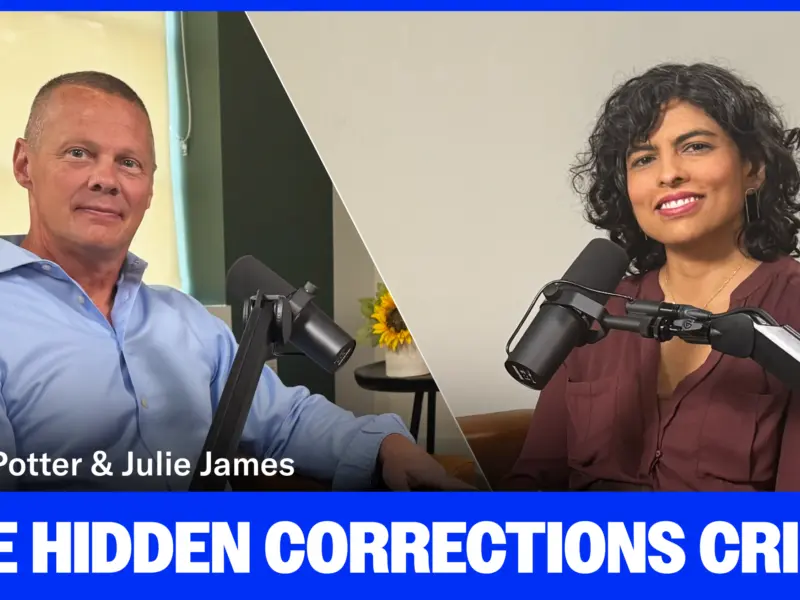
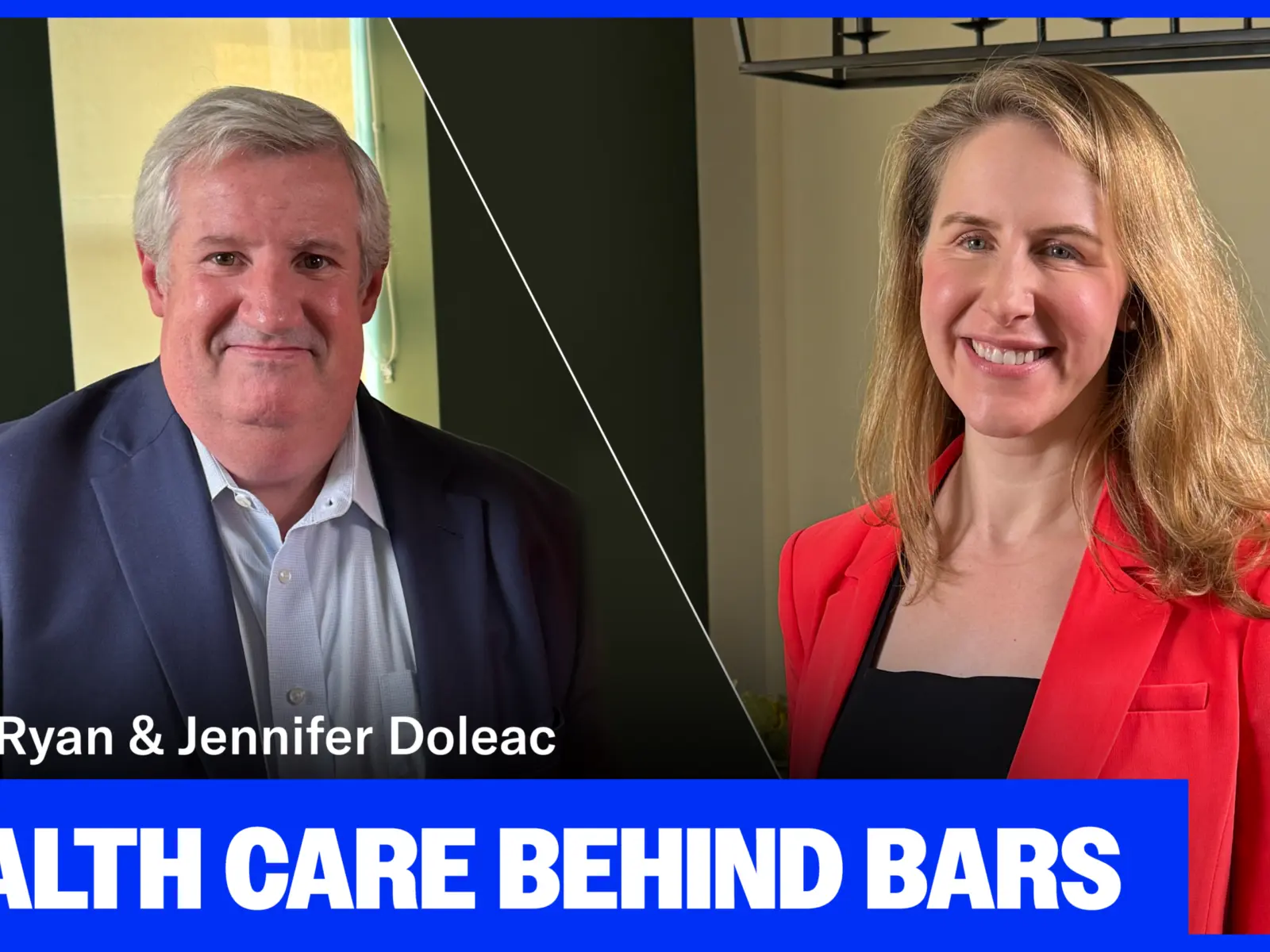
Julie James: Prisons are meant to keep communities safe, but what happens when the prisons themselves aren’t functioning properly? Staffing in America’s prisons has become one of the biggest problems facing the justice system. Recruiting and retaining officers is increasingly hard, and the impact reaches far beyond the prison walls.
In this episode, Jennifer Doleac talks to Mike Thompson from the Keystone Restituere Center for Justice. It’s a policy and research organization that works with correctional agencies across the country to improve how prisons are run using data and evidence to drive change. They talk about what the scale of the prison staffing problem means for the people working inside facilities, what better-run facilities actually look like, and whether fixing the system could improve conditions and public safety.
Here’s Jennifer and Mike.
Jennifer Doleac: Mike, thanks so much for joining us.
Mike Thompson: Thanks for having me.
Jennifer Doleac: So to start, maybe you could just paint a picture for us about what it’s like in correctional facilities in the US today, especially for the officers who are working there.
Mike Thompson: So corrections directors across the country turned to me and John Whetsel, who is a lifelong corrections professional and one of the most respected corrections administrators in the country, to really help them get the finger on the pulse of the workforce challenges that they’re facing across the country.
And they asked us to, in addition to looking a hard look at the data, to go to some facilities across the country. And so we went to a number of states and spent a lot of time in some different prisons in those states. And I’m thinking just instantly of this one prison that we toured.
And when you’re in a prison, as I know you’ve spent time there and, when you’re there, you’re trying to sort of just pass the time because you’re just always waiting for people to escort you through different parts of the facility. And so we were sitting there killing time and shooting the breeze with one of the facility managers.
And I looked at his desk, and he had pictures of kids, and I was just trying to shoot the breeze with him. And so we got to talking about kids ’cause we have kids the same age. And as we’re, as we’re talking, we realized both of our kids decided not to get their driver’s licenses too soon.
And, you know, we’re sort of remarking about how different things are today. And that started a conversation, and I was like, “So, you know, do your people, some of your kids some of your employees not drive to work?” And he’s like, “Well, you know, come to think of it, we have a lot of staff these days who are actually dropped off by their parents at work.”
Oh, wow. And I was like, “Wait, your corrections officers are dropped off by their parents at work?” And he’s like, “Yeah.” And he’s like, “You know, sometimes we’re doing interviews, and their parents come with them to their job interviews.” And we’re just like, man, kids today, such a different kind of working environment.
Mm-hmm. But these are their corrections officers. So I didn’t think too much of it, you know. I was sort of walking outside of the office. And as soon as you walk out of these air-conditioned offices, and then you’re blasted by the heat. It’s, like, 100 degrees. Mm. You know, and then your glasses are fogging up.
So we walk over to the housing unit, and I’m with John Wetzel, who’s a lifelong corrections guy. I’m more of a politics, communications, policy guy. and we’re in the housing unit, and we’re talking to this officer. And they’re in the control center of the housing unit. And so you sit inside the control center, and you look out across the different cell blocks.
And we’re asking the officer how many people are assigned to this housing unit where there’s about 200 people living. And he says, “Well, you know, in theory it should be, like, four or five people. But we’re so understaffed, it’s often just me.” And we’re like, “You inside this control center?”
And he said, “That’s right.” And we said “How long you been working today?” And he said, “Well, I’m about six, seven hours in, but I don’t know if my relief officer is gonna show up. And so if my relief officer doesn’t show up, I could be here for 16 hours.”
Jennifer Doleac: Oh my gosh.
Mike Thompson: And, you know, I’m still taking all this in, and Wetzels, I call him, says starts asking questions about the housing unit rounds then-
Jennifer Doleac: Mm-hmm
Mike Thompson: They have to do, because there’s this expectation that you’re going out into the housing unit. And he says “So how often are you supposed to be going out? You know, what are you doing with your housing unit tours?” He’s like, “Oh, you know, we go out, you know, once every hour or more frequently, you know, to do a round to, and talk to the people incarcerated.”
And he’s like, “But seriously, like how often are you getting out?” And he’s like, “No, no, that’s what we’re supposed to do.” And he has this way of asking more and more questions, right?
Jennifer Doleac: No, really. No, really.
Mike Thompson: Right, really, right? And and he’s like, “Well, man,” he’s like, “you’re all alone in here. And you walk outside this control center, and it’s at nighttime, and you’re walking to the end of the cell block.
And you know, one of these people incarcerated has jammed something in their cell door and they can just throw that thing open, hit you, and you’re on your own. And that’s a scary situation.” And he said, “What if you just need to go to the bathroom?” And he said you know, I gotta wait for an officer to show up, and sometimes we can’t have, you know, a way to go to the bathroom for two, three hours, even longer.”
And so I’m taking all this in, and I’m going back to the conversation that we had when we first came into the facility. And I’m thinking about my daughter, you know? And they’re now… 18 years old is the minimage to work at this facility. About 40% of the staff are female.
So a lot greater percentage of the workforce is female, say, than in policing. And I’m thinking, imagine your 18-year-old daughter is working in this control center, and she’s been there 15 hours, and you’re thinking, is she gonna go leave that control center, walk to the end of the cell block in the middle of the night and check on somebody?
That’s a scary situation to be thinking about, and then dropping your daughter off, picking her up after work.
Jennifer Doleac: Can they have cell phones in the facility?
Mike Thompson: Right. And so you are not bringing in any sources of communication.
Jennifer Doleac: Right.
Mike Thompson: So you have no source of communication to the outside world, ’cause, you know, that, that can be potential contraband.
Jennifer Doleac: So if you need help, or if you need to tell your mom not to come pick you up.
Mike Thompson: Right, right. No, you, you, there’s, you’re not gonna have any communication with that person.
Jennifer Doleac: Yeah.
Mike Thompson: And that’s just on the person who’s working in that facility. We haven’t even talked about the people incarcerated and what the implications are for them.
Jennifer Doleac: Mm-hmm. Yeah, and I think that all of that is, I what is so fascinating to me about the work you’re doing and, and some other groups out there is, is really trying to bring to light this issue of understaffing and what, what staffing in these facilities are so what staff in these facilities are going through.
‘Cause I think people do hear more about the inmate side. But but it hits different when you realize we need people working-
Mike Thompson: That’s right, yeah.
Jennifer Doleac: … In these [00:07:00] prisons and jails, and, and it’s, it can be terrifying.
Mike Thompson: Yeah. And the health and safety of the people incarcerated depend on those people working in there.
Jennifer Doleac: Exactly. So I think I read in something you all put out that 81% of state DOC leaders, Department of Corrections leaders agree that workforce issues are their top priority. Mm-hmm. So it’s not rehabilitation, it’s not re-entry, other goals, which I suppose all depend on the staffing issues.
Right. But staffing is basically front of mind. What’s your take on- the underlying causes here. How did we get to this point?
Mike Thompson: Yeah, no, it’s that survey really struck me. you know, it’s 81%, as you pointed out, said it’s their number one challenge. The remainder of this, of the folks said it’s their among their top challenges.
Only one director in the entire country said it wasn’t their top priority, and which is so different than corrections, say, when I was starting, when every legislator was tugging at a corrections director’s sleeve saying, “Can you employ my nephew?”
You know, now this understaffing is, in fact this incredible challenge, and it’s being sort of driven by a number of factors that are converging.
Some are just, you know, generally what’s going on in the workforce. So, if you talk to anybody in state government whether it’s you know, teachers or if you’re talking about healthcare workers or even the snowplow drivers you know, everybody talks about how they’re understaffed in those different agencies.
Jennifer Doleac: Yeah.
Mike Thompson: And that’s a, a result of demographics and fewer people for more jobs that are out there. So, that’s just, like, one sort of demographic shift. The other reality is, is that these prisons were constructed in parts of the state designed to kinda create economic development, so in heavily rural areas, and those are the areas where you’ve had sort of the aging of the population, fewer and fewer people who are younger looking for jobs.
Mm-hmm. So that’s just, like, these demographic pressures, but especially acute in the corrections area. The second is, is when you got, sort of more job opportunities, corrections looks less appealing to a lot of people. You know, we were just describing sort of the realities of, of the job. But we also know that a corrections officer’s far more likely to experience violence than other people.
So, for example twice as likely to experience violence on the job than a police officer. and that’s far greater than any other job, like working in an Amazon warehouse. So, that’s a, a second big factor. And then a third factor is then, you know, you’re gonna hit this overtime, and overtime used to be almost like a perk on the job.
But now you’re gonna go in, and it’s gonna be mandatory overtime. You can’t just sort of bid for an extra shift or something.
Jennifer Doleac: Yeah, your replacement just doesn’t show up when you’re planning to go home.
Mike Thompson: Your replacement doesn’t show up. And there is nothing more frustrating to people, especially younger people when they’re told that they’re not gonna have their days off and they can’t predict their schedules.
And if you’re talking about young parents who wanna be there for, you know, a baseball game on the weekend or whatever, and so that’s causing a lot of frustration on the job. And [00:10:00] so you add those different factors- and you’re getting a, a very high turnover rate on the job. And so what we’re seeing in corrections when we talk about just general workforce strains, demographics, difficult working conditions, overtime, you can talk about that in teaching, you can talk about that in healthcare, but it’s especially acute in the corrections area.
And so we see vacancy rates and turnover rates in every state in a corrections department that far exceed the similar rates of the state agencies in that same state for other work sectors.
Jennifer Doleac: And we talk a lot at Arnold Ventures about the corrections crisis. Really, really saying that it is a crisis.
And it’s, it’s you know, kind of scary to think about how this then becomes a vicious cycle, right? You have the understaffing, which means that you’ve got this one guard who is all alone and maybe maybe, you know, worried about violence, and then they quit.
Mike Thompson: Right.
Jennifer Doleac: And then that means you have even fewer staff-
[00:10:58] Mike Thompson: That’s right
Jennifer Doleac: and it’s even worse for [00:11:00] the people who are left, and it just becomes harder and harder.
[00:11:03] Mike Thompson: That’s absolutely right.
Jennifer Doleac: That brings us to, you know, what the broader impacts are. There are obviously impacts on the individual staff. This isn’t a fun job.
[00:11:09] Mike Thompson: Right.
Jennifer Doleac: We should figure out how to make it… You know, we need more people to be helping run our jails and prisons and make it more appealing for them.
But talk about the broader impacts. Yeah. What are the impacts on, kind of, on the people who are living in the prisons as well?
Mike Thompson: Yeah. I think when you talk to elected officials just generally who aren’t particularly focused on corrections issues or if you talk to the public and you say you know, “Did you know that corrections is understaffed?”
And they say, “Well, I, I knew that schools were understaffed. I knew that maybe policing, certainly nursing. No, I didn’t really know that the corrections was facing sort of a staffing crisis.” And like, “Well, you know, doesn’t that concern you?” And, “Not really.” You know it’s a, you know, not a great place to work.
It’s difficult. And so then I realize we’ve got the challenge of actually explaining to people why they need to care so much about this. Why this matters. Why this matters. Yeah. [00:12:00] Absolutely. And what’s really interesting is, is that when you talk about other criminal justices issues these days and why this matters and what we do about it, I feel like you’re gonna likely start to see a division along partisan lines along certain ideologies.
We didn’t use to have that as much 10, 20 years ago, where we started to see some real nice consensus emerge across a lot of issues, but we’re now we’re seeing divisions again. But when I go through these issues that I’m about to articulate I find it really interesting that you’re not gonna find a conservative or a liberal who’s gonna not feel compelled by at least one or two of the reasons I’m about to cite.
So the first is just the general size of the workforce. When you go and bring all state government employees in a room, and then you ask them to raise their hands for which agency they work you will find that the most hands go up to say, “I work in the Department of Corrections.” So it’s maybe the Department of Human Services, but generally, no matter what the state, corrections [00:13:00] is your biggest employer, your second biggest employer, hundreds of thousands of employees.
So just a huge workforce and lots of families affected, and they are experiencing increased violence and dangerous working conditions. So that’s number one. And number two is for the people incarcerated. As we’re understaffed and we talk to people who are have loved ones incarcerated, or we talked about community members who are getting ready for somebody to come back out of prison and wanna make sure that person’s prepared, both in dealing with health issues and addiction and th- their children that requires a lot of programming, of course, while the person’s incarcerated.
And those programs are being cut back because we don’t have the officers to take people to those programs, to allow people to come into the facilities, so we’ve got diminished access to programs. So that concerns some people from some perspectives. A third area is just general public safety.
You know, you mentioned the survey that we talked about a little bit earlier. Another [00:14:00] fascinating finding from that survey was approximately one out of five corrections directors saying that they are considering, have already engaged the National Guard, or are thinking about pulling in the National Guard because they are so understaffed.
And so when you just think about the safety of a community and making sure that people are locked up, and it’s so understaffed that we’re pulling in the National Guard to deal with that, then you gotta be concerned about public safety. And then the last issue is a fiscal issue, which is, I mentioned the overtime that’s occurring, and that has huge fiscal implications.
So just in the state of Texas alone, for example, they’re now spending $300 million a year on overtime expenditures alone, and that number has skyrocketed since 2019. It’s showing no signs of decreasing, and that’s just not a Texas issue. It’s Vermont, it’s Michigan. It’s a matter of where you look, overtime expenditures are surging in corrections, and they’re growing at a much faster rate than overtime expenditures for any of these other state agencies.
So you’ve got a fiscal issue, a public safety issue, a [00:15:00] human issue, a workforce issue, and I find that no matter what your politics are, you’re gonna find that at least a couple of those issues resonate with you.
Jennifer Doleac: Jennifer Doleac: So if we don’t fix this, where are we heading?
Mike Thompson: To a really dangerous, expensive, unhealthy place.
Yeah, and I think that’s why you’re hearing corrections say, “This is our number one challenge.” and it’s why I think we’re now engaging more people to realize this is a big public policy issue where we need to be focusing.
Jennifer Doleac: Yeah. All right. So let’s turn to Keystone and what you all are doing to address all of this.
Yeah. What are you working on with Keystone, and, and how do you, how are you hoping that that’s gonna help?
Mike Thompson: Yeah. So when we look then at what are you doing to address this challenge, and we’re talking to corrections directors across the country and state leaders, the number one action people are taking is raising compensation.
Increasing salaries. And, and I don’t mean just a little. I mean, we’ve got salary increases from Idaho to Florida, Georgia, where you’re seeing salary [00:16:00] increases 50, 60, 75% over a, a few years, so huge increases in salary. But that is, that is having an impact. We are seeing some reductions in vacancy rates as a result and improved hiring, but it’s not resolving the workforce issue.
It’s not the silver bullet. And so the question that we’re sort of working with corrections directors on then is, well, what do we do as a result? What should we be employing? And we’re finding that every state has a gazillion different random, fairly fragmented kinds of initiatives, different kinds of uniforms, new policies on tattoos you know reclining chairs in the back, in the break room.
I could go on and on about sort of different initiatives that are being employed. But what directors don’t have is much data telling them that this biggest challenge that their system’s facing with all these high stakes, any information about what’s working and what’s not working. I find it really interesting than when you go back 10 years ago, for example, and not a lot of states had recidivism data, and now [00:17:00] every legislator expects their director to talk about recidivism and what, how things are trending in their states.
Right now, directors will tell you that they know far more about their incarcerated population than they do their workforce. And so right now at, at KRJC, we’re spending a lot of time really looking hard at the data, the data corrections directors should be getting, and then some of the insights that that’s giving us about what needs to change.
Jennifer Doleac: So how do you collect this data that didn’t exist?
Mike Thompson: Yeah. Well, it’s really interesting I, you know, you talk about these largest employers in state government, lots of them don’t even manage the data regarding their workforce. it’s maintained by a totally separate state agency, which is responsible for all HR data.
So they are finding themselves having to knock on the door of another state agency and look at data that’s maintained in a totally different way.
Jennifer Doleac: Is that common in other agencies, like in policing or in schools?
Mike Thompson:Yeah it really depends on the state and stuff. But no, corrections has been told to outsource a lot of its information to these other state personnel agencies, and there’s no question, I find, that in education and in healthcare that those administrators know far more about their workforce than the corrections leaders do.
Jennifer Doleac: So why do you think this hasn’t been done before? I mean, data, like you said, like we’ve been-
Mike Thompson: Yeah
Jennifer Doleac: … pushing for data, other industries have this data.
Mike Thompson: Yeah. So I was working with corrections directors back in the early aughts, and telling them that there was an increased expectation that we know how effective they’re being in reducing the likelihood that someone’s gonna re-offend.
And at the time, that was considered just sort of completely unfair and, and unrealistic. much like police officer- or police chiefs were being told in the ’90s, you know, “You’re responsible for reducing crime,” which they said, “No, that’s, that’s influenced by so many things out of our control,” right?
So corrections directors, I think and, and administrators made a big shift in the aughts, recognizing that they were gonna be held accountable for recidivism, needed to produce that data. I don’t think enough people are asking them about some of their workforce trends. And I think that’s what’s gonna need to change.
I think we’re gonna need outside groups asking more information legislators, advocacy about what’s happening in the workforce. And what they’re gonna find, and this is where it gets really interesting, is that we don’t have necessarily a recruitment problem, we have a retention problem. And what we’re seeing through the retention data when we start to really examine it is just how quickly people quit their jobs after they start in corrections.
And so just a testimony that the Secretary of Corrections from the State of Florida just gave earlier this year to his legislature was that the average corrections officer has far less time working in prison than the average person incarcerated has living there. So you actually have a situation where the people incarcerated have more experience understanding the way that prison should work than the [00:20:00] corrections officers themselves.
We’ve got situations where half to three quarters of the corrections officers who are hired quit within the first year that they start which has enormous fiscal implications for recruitment and then when you train them in Texas, and I, I mention Texas now a couple times, not because they’re particularly bad, but because they have such good data so we can actually quantify things in ways we can’t for other states. But they are hiring about as many officers as they are losing every year. And when you figure that’s about 8 to 9,000 officers a year, and you look at that then over, say, a nine-year period, that means they’ve hired and lost approximately 70,000 officers, which means that they’ve turned over their entire workforce multiple times.
And as bad as the turnover is in other sectors, you don’t hear about that anywhere near as much as. You know, the, the data’s far more exaggerated, far more acute, what we’re seeing in, in corrections. And so what we really need to [00:21:00] do is start to parse those numbers in retention further, and that’s where we’re seeing some really interesting opportunities to do better.
Jennifer Doleac: Okay. So tell us a little bit more about, you’re getting this data in. Mm-hmm. What, what are you hoping to do with it?
Mike Thompson: Yeah, I mean, we wanna get corrections directors first of all to see when exactly are we losing these officers? Who are we losing? Why? you know, a really interesting question for example, when you go and you recruit an officer who are we targeting to work in these facilities, right?
A lot of corrections folks thought, “Well, let’s get retiring veterans or people who are leaving the military. They’ll, they’ll enjoy working in a paramilitary sort of environment.” turns out that they leave even faster than people-
Jennifer Doleac: Oh, interesting.
Mike Thompson: … who are not military. I talked to a person, a former Marine in a, in one institution and he said, “The military was the worst training ever for this job.”
He said the… He said, “I don’t… Everything they trained me in the military has no application here whatsoever in a corrections system.” He said, “I did sell cars for a couple years.” And he said, “And that taught me a lot about how to work in a corrections system because-”
Jennifer Doleac: Okay, wait. Say more. Why, why, why?
Mike Thompson: All I’m doing every day is trying to explain to people why to do something, and all I have is my voice.” And he said, “And that really reminds me a lot of trying to sell a car.” He said, “Doesn’t remind me a lot being all geared up going out into some village you know in a Humvee.” And so that really sort of drove the point home for me. Wait, wait a minute, who are we recruiting, right? and again, I, I mentioned that large numbers of women working in corrections, right? And I’m sort of fascinated with the question, you know, why is it that a lot of the male officers say, “Well, the, the women seem to be a lot better at encouraging the men what to do,” sort of you know, getting back into their cells, where they need to be at a certain time.
And you know, that sort of is just raising questions of what characteristics are we looking for in an [00:23:00] officer. And right now, you’ll talk to a lot of corrections departments and, you know, one recruiter told me, “Look, I’ll be honest, we’re looking for anybody who fogs a mirror.” and you know, when, when that’s the reality, then they know they’re bringing in somebody who isn’t necessarily bringing the kinda culture they want into that system, which may be actually driving away the very same employees who we’re most interested in retaining.
And so we’re starting to try to get a lot more strategic about who we’re actually going after. Maybe we actually have to raise the floor of who we’re actually hiring. It means we’re gonna hire fewer people, but if it increases their retention rates by a certain percentage, we’re gonna be doing a lot better.
Jennifer Doleac: Right. Reminds me of a lot of conversations about law enforcement too, where there are also staffing challenges, though not as acute. In corrections, we hear more about them. but I think, I think a lot about, you know, if you want to have more people in these jobs, then you need to find a way to recruit more and different people than you have in the past, right?
Mike Thompson: Correct.
Jennifer Doleac: And so necessarily, [00:24:00] the messages, the, the pitches the maybe eligibility requirements are going to be have to, have to be different than what we’ve tried previously, because we want to get, we’re trying to reach different people than we have in the past in order to expand our net.
Mike Thompson: 100%. I just spoke to an HR director from one large system this week, and she said you know, historically, we’ve had billboards of K‑9 units. You know, we got a bunch of officers in uniform, sometimes in tactical gear you know, hands on hips saying, “Come be a part of our family,” and that was sort of their pitch.
And we realize people are coming in, and then the- their first day on the job, this is like, “This is not what I thought I was going to be doing.”
Jennifer Doleac: Yeah. It’s just me. Where’s the family?
Mike Thompson: Yeah. And, and, and, you know, we’re, I’m not with the K‑9 unit. And, you know, we’re not out there, you know, kicking butt, doing these kinds of things.
We’re just talking to people, you know? Mm-hmm. And then we’re trying to help them change their lives, and they realize that the people who are actually most motivated probably to work in those systems and stay were people who actually wanted to be engaged in [00:25:00] helping people change their lives.
Jennifer Doleac: Yeah.
Mike Thompson: And so they thought to themselves, “Is that what we’re really advertising? Are we talking about the opportunity to engage with people who wanna turn around their lives?” And that’s just a totally different recruitment message. And a totally different onboarding experience. And so I think that’s, like, an example of how we might see some culture shifts in some of these agencies, not just because it kinda feels right, but it ends up getting you better retention rates and starts to address those fiscal public safety health issues we were mentioning earlier.
Jennifer Doleac: It’s just a better match for what the job is.
Mike Thompson: Absolutely. Yeah. And along those lines, we’re also seeing corrections administrators say, “Maybe we need to rethink just how we staff a prison altogether”-
Jennifer Doleac: Hmm
Mike Thompson: which can really sort of beg the question then of is there a way to have fewer staff in this institution but actually make it run better? Because we’re seeing two facilities that are nearly identical you know, within a stone’s throw of each other. One’s understaffed. The other appears to be fully staffed.
The one that’s understaffed, though, has a [00:26:00] higher retention rate and less violence occurring in the facility than the other one, and the question’s like, what is going on? And I talked to a corrections administrator, a director who went to the two prisons ’cause he was so curious as to how these two things could be sort of seem to be this paradox.
And he went into the the facility with, it was understaffed, but everybody was showing up for work and people liked working there.
And he said to the dire- the warden, he said, “What are you doing?” And he said, “Well, we’ve decided to open up the facility, you know, that we used to really be on lockdown because we were so understaffed, and we’re actually now allowing a lot more movement across the facility.”
“We’re having more programming, a lot of it really directly involving the people incarcerated actually running some of the programs. It’s a totally different model of how we’ve typically and historically run this institution. It actually requires less staff as well.” And the superintendent or the director of corrections said, “You know that violates a whole bunch of policies that we have in our agency?” And he said, “Yes, sir.” [00:27:00] and he said “Who authorized you to do this?” He said, “I didn’t ask anybody.” he said, “Good for you. Keep it up.” And, and a lot of directors of corrections say that one of the things that they’re worried about is that they’ve created such a rigid environment that it doesn’t really allow a lot of flexibility and innovation.
Jennifer Doleac: The creativity, yeah.
[00:27:20] Mike Thompson: The creativity at the institutional level. And it’s just with some of the data and maybe, maybe some of the the oxygen you’re giving these folks to maybe think differently and then some of the data to measure the impact, and I think we can experiment with a whole bunch of new staffing models that are more efficient, get you better outcomes, and we also feel like are much better living conditions for the people incarcerated.
Jennifer Doleac: So I imagine that some people who are coming from a more liberal perspective might be listening to this and, and thinking, you know, “The last thing I want is to invest more money in corrections and more money in corrections officers. I want a smaller footprint. I want fewer people incarcerated.” But it does seem that [00:28:00] if we want, you know, better programming if, in, in prisons, we want to use prison as an intervention point to help pe- put people onto a better path when they come out, back out into their communities then we, we probably need to be able to be choosy about who we’re hiring into these, these really important roles.
The people who are staffing these, these facilities are really important, as integral to that, that whole system. And if we wanna be choosy about who we’re hiring, we need a line out the door of people who want that job. You can’t, we can’t be in a position where you just need anyone, just a warm body to staff that position.
Mike Thompson: Yeah. Yeah. No, that’s absolutely right. it’s, it’s super important that people understand that this isn’t an either/or proposition that we need to make sure that this is a job that is hiring top quality talent. But at the same time, it’s not a question of should the corrections footprint be smaller or bigger?
There is a way to hire the right people and actually, I think, at the same time, shrink the footprint of the system by actually better preparing people for release, putting them in the facilities that they are a, a better fit for. You know, I think about a, a person incarcerated that I talked to and I was asking him, “Of all the programs you participated in, you know, which program did you feel had the biggest impact on you?”
He’s a very successful entrepreneur after he’d left. I thought he was gonna talk about a particular kind of a job training program or something else, and he’s like, “I don’t remember any of the programs or their names.” And he says you know, “I remember Miss Jenny you know, and she was a person who I met with every week, and she had a lot of faith in me, and she had a lot of confidence in me, and she and I talked a lot about what my future was gonna look like, and that kind of inspiration is what motivated me to change a lot.”
And I was just sitting there thinking like That’s, makes so much sense. Yeah. It’s, I mean, like, why would I think that it’s this program any more than I go back to school and I think [00:30:00] about, you know, it was-
Jennifer Doleac: That English class. Yeah, right? It was the, it was the teacher.
[00:30:02] Mike Thompson: Yeah, right. Yeah. It was the, it, you know, it was that sort of w- curriculum that they gave me.
Jennifer Doleac: Yeah, right, right.
Mike Thompson: No, it was the teacher. And of course, when we look at the, the literature, the research, right? We, we now know about the importance of teacher quality influencing outcomes, and we need to be thinking about the same thing, about the quality of the workforce that we have there. And absolutely, that’s gonna take a total rethinking of things. But to, you know, my friends who also talk about, you know, “This just illustrates that the system’s too big, that we should have fewer people in prison.” You know, I just… that’s certainly, you know, I think a, a very valid point, very valid argument.
We are seeing state prisons grow right now in terms of their prison population, so we’re actually seeing an even greater demand you know, on officers, and we’re asking them to do more. But I do think it’s worth asking, like, do the facilities need to be constructed the way that they are? Mm-hmm. Is there more staff, sort of, efficient ways of doing some of these things?
If you’ve got a geriatric population do you really need them in a facility where you’re helping people up and down stairs you know, all the time? Where you’re wheeling them around, you got officers taking them to multiple appointments. Couldn’t you put them in a facility that more resembles something like a nursing home?
That actually might be more staff efficient to, to, to run. Couldn’t you put civilians in some jobs that you’re actually asking corrections officers to do? So I think when you start talking about, like, facilities, reimagine people in more community-based type of organizations, people who are looking for a smaller footprint for the corrections system can say, “Oh, I can get behind that.”
Jennifer Doleac: Yeah.
Mike Thompson: So I, this is where I do think that no matter what your angle on this issue, you see opportunity to do things in a better way.
Jennifer Doleac: Yeah. Are you finding that as you’re going out and, and talking with corrections staff around the country and trying to collect all this data, do you feel like people are, you know, eager to share their experiences with you?
Or are they, are they nervous about telling you, kind of, what their challenges are?
Mike Thompson: My sense is there’s a lot of frustration, [00:32:00] anger, and pain in, in the workforce right now, and they feel that they’ve been abandoned ignored, forgotten about. And they are reluctant to share a lot of information.
You know, one of the things that I hear a lot from people who I’m trying to convince about the importance of this issue, and they say, “Well, what do, what do people say when they do their exit interviews, for example, about why they leave,” right? And I’m like, “Well, first of all, most of these people aren’t submitting any exit surveys.
They just sort of drive off the lot, and they never come back to work. And people only realize that they’ve quit when they stop showing up. And so they’re not filling out any exit sort of surveys.” And like, “Well, what about just surveys of staff generally like you normally do?” I said, “in many of these systems, the staff don’t have email addresses. So the way you would survey them would be paper and pencil. You know, maybe you can get cell phone numbers and do some sort of text survey.” But the first question corrections or officers are gonna ask you is, ‘Why do you want this information? How is it gonna be potentially used against me?’[00:33:00]
There is not a trusting environment because they’re in situations right now where they don’t know how long they’re gonna work. They feel that administrators tell them it’s gonna get better, and it’s not necessarily always the case and so you’ve got a lot of situations where morale isn’t that great among frontline staff, and that’s why we feel this is such an urgent issue, and that’s why corrections directors are doing everything they can to address it.
We’re just gonna need more people, I think, bringing their weight to the issue.
Jennifer Doleac: Yeah. So what are you expecting to see from the reports that you’re generating here?
Mike Thompson: Well, I’m, I’m hoping, first of all, that we can really persuade a lot of different audiences that this is something that they need to care about.
Because again, right now, I just don’t think there’s a lot of public attention on it. And if you go to sort of the shifts that we saw in criminal justice over the ’80s, ’90s, aughts, et cetera we really started to engage people on discussions around reentry when they realized how many people were gonna be coming [00:34:00] home.
Mm-hmm. And the public safety implications, the health implications. Then you know, when it was around growing prison populations, I think we helped them understand about the implications for state budgets and how much that was going to cost. And it was really when people felt that it had some consequence for them that they started to care more, and I’m hopeful that the report will show them, you know, for the reasons why we were talking about it earlier, that they do have a stake in this issue.
And then once that’s the case, then I’m hoping we’re gonna get a lot of people taking a harder look at the data, because they’re gonna realize that our strategy so far, pretty fragmented, and we’re gonna need to be a lot more strategic about this. And maybe we wanna rethink a whole bunch of things that we’ve historically just taken as a given in corrections.
So, do we do 11 counts a day, or do we do three counts a day?
Jennifer Doleac: Hmm.
Mike Thompson: Do we search cells every day or every fourth day? Do we think differently about how people can move across a system and the kind of escorts that they need? These things have huge staffing implications. And the question [00:35:00] is, could we take a step back and kind of create a more trusting environment?
I mentioned the distrust that a lot of frontline staff have, where we could have those people come together, frontline staff, people who are incarcerated too, ideally, who know how that system is playing out on a day-to-day basis, plus some of your central office folks, and reimagine the way that that institution can be staffed, and start to build a whole new staffing complement for the system, and then measure whether that’s resulting in improved retention.
So I think that’s the, you know, one of the big directions we wanna see ourselves going in.
Jennifer Doleac: So you mentioned earlier that part of the challenge here is that- you know, the directors, the people who might be in a position to try some of these new things don’t feel like they have the authorization to do it.
Is that changing? Is that a conversation you’re having with, with leaders kinda further up the chain?
Mike Thompson: Yeah. I think the, the directors themselves often feel like they have the leeway to do it. They often though aren’t that long in the job. They’ll be there for two, three, four years ma- [00:36:00] you know, the average tenure of a corrections director, I believe, is a little over two years.
And a lot of corrections directors have not worked in corrections before. And so you get a large middle management that is often accustomed to seeing a lot of turnover in that director position. And then you get people at the facility level, who often feel pretty hamstrung by policies that middle management is not necessarily changing.
And so you need like a through line from the director through middle management through the facility level that is saying it’s okay to try a lot of new approaches. And I do see a number of directors really pushing that kind of mindset, but you’re talking about a total change in culture of a system, and that’s gonna take a while.
Jennifer Doleac: Yeah. Do any examples come to mind of like specific states or specific, you know facilities or, or systems that are doing this well that are good examples?
Mike Thompson: Absolutely. You know, I just… I mentioned Florida, which, you know, is a system so understaffed they’ve had to [00:37:00] pull in the National Guard. But they have actually introduced this notion of incentivized housing, where they have challenged a lot of traditionally held norms about the way movement would occur across a facility and increasing access to programming, which a lot of people thought was gonna be more staff intensive but they actually believe is a more efficient use of staff. And they’re showing that, correlate with increased participation in programming.
And by the way, again, sort of for my friends who are looking at this as, at how to affect the overall number of people incarcerated, more people in programming, more people getting earn time, more people positioned for parole release. And so that is one example. In Missouri, they’ve totally rethought how someone goes through a training academy so that people talk about a training academy experience which doesn’t look at all like what the job looks like on day one.
They’ve changed that experience. They’ve also made sure that when you say yes to wanting to be hired, you start right away because they found that [00:38:00] there was a lot of lag time and typical government bureaucracy of actually getting you started. And as a result, somebody else would find another job, and so they need to move faster.
So that’s a- another example. In Idaho, they’ve done a really nice job actually thinking about how they can help officer wellness, and so what do we do to help you cope and deal with a tough work day? And they’ve actually seen some improvements in staff retention there as a result.
Jennifer Doleac: Oh, amazing. So a lot of this is gonna take a lot of work.
It’s not gonna be an overnight no overnight solutions here. But are there are there areas where there’s some low-hanging fruit, some easy fixes that could be made that you’d love to see?
[00:38:38] Mike Thompson: Yeah. I just go back to this data issue. I really feel that we should be having legislators asking, “What is our one-year retention rate?”
In the same way that they’re so used to asking about recidivism rates. It’s not a question they’re accustomed to asking. They’ll ask about vacancy rates, but, “Of the h- officers we hired over the past year, what percentage are still on the job? Why do you think that?” you know, “What, why do you… Is… [00:39:00] Are you pleased with that retention rate?”
So I think just sort of getting elected officials and advocates as well to start asking questions, and then having Departments of Corrections have the courage to be transparent about the data. The data, when they start to come to light, and they show these really, frankly, embarrassing retention rates, and they show increased rates of violence in the facilities can cause a lot of people to say, “You know, this is gonna embarrass the governor.
This is not a good idea to share this information.” In fact, we’re seeing less information than ever often reach public spaces about what’s going on in corrections. And I’m seeing some of the most experienced directors, who are lifelong corrections professionals, have the courage to say, “Only when we talk about this in a transparent way are we gonna get more help from a lot of these folks.”
And I think that’s the absolute right way to do it. But it seems counterintuitive to a lot of people working in a very political environment, you know, where there’s a lot of gotcha politics. So I’m very [00:40:00] focused on just trying to bring a little more data to light and having more of these outside stakeholders ask the right questions, and then armed with this information, start to experiment with the strategies we’re talking about.
Jennifer Doleac: Yeah. Love data, and I’m, I’m a researcher by training, so so what comes to mind immediately for me is, as you’ve got all this innovation and places trying new stuff, partnering with researchers to actually be able to say, like, “Did this move the needle in the way you were hoping?”
Mike Thompson: 100%.
Jennifer Doleac: “How can we do even better?”
Mike Thompson: 100%. And, you know, you go back to these two prisons that I talked about that are a stone’s throw from each other with remarkably different experiences in terms of retention rates and levels of violence in the facilities. Being able to measure, you know, what are some of the things that are correlating, what, you know, what is it?
Is it… Go back to my education example, right? Was it class size? Was it per spending per pupil? Was it the curriculum? It turns out it’s the teacher quality.
Jennifer Doleac: Well, that’s all we’ve got time for today. I should let you go. Thank you for listening or [00:41:00] watching. Subscribe for more conversations, and we’ll be back soon.
Bye.