AV Issue Brief
The great economist Thomas Sowell once said, “there are no solutions, there are only tradeoffs.” No political exercise encapsulates this mantra more than tax reform. Today, lawmakers face an urgent opportunity to “do both”: preserve pro-growth elements of the 2017 Tax Cuts and Jobs Act (TCJA) while being fiscally responsible so we don’t add to the nation’s unsustainable debt.
As lawmakers consider how to extend the major provisions of the TCJA, they must make tough decisions that balance multiple priorities: boosting economic growth (not every tax cut is pro-growth), addressing distributional considerations (who pays and how much?), determining revenues needs (do we raise more or less?), and compliance (does the reform simplify the code or make it more complicated?).
TCJA’s drafters made many similar decisions in shaping the most significant rewrite of the tax code since 1986. For example, in exchange for a permanent 21 percent corporate tax rate, lawmakers eliminated scores of deductions and loopholes that benefited many corporations. Some corporations were left with a higher effective rate after TCJA. But the economy — and U.S. competitiveness — benefited overall from the lower permanent rate.
Likewise, lawmakers replaced much of the individual Alternative Minimum Tax (AMT) by capping the state and local tax (SALT) deduction at $10,000. While some taxpayers saw an increase in their tax burden, more than five million others no longer faced the AMT — an often-hidden tax.
Extending TCJA now is even tougher because lawmakers must find a larger set of offsets to minimize the $4.5 trillion deficit impact of extending the TCJA.
Could C‑SALT Be The Next Big Tradeoff?
One of the more hotly discussed offset options today is limiting the SALT deduction for corporations, so-called C‑SALT. While TCJA limited the SALT deduction to $10,000 for individual taxpayers, it made no changes to the deduction for corporations. Now, some lawmakers suggest applying the cap to corporations too, to raise revenue and equalize tax treatment across business types.
Tradeoffs can have unintended consequences. The original SALT cap impacted the individual owners of pass-through businesses such as S‑corporations and LLCs who were accustomed to deducting the full measure of the state and local taxes paid by their firms on their individual 1040 forms. Naturally, they thought it was unfair that Fortune 500 companies could continue to deduct their state and local taxes while pass-throughs could only deduct $10,000 worth.
As a remedy, they lobbied state lawmakers to craft workarounds that allowed them to deduct state and local taxes at the firm level, much like traditional C‑corporations are allowed to do. While this may seem fair on the one hand, these workarounds greatly complicated state tax codes and created another disparity in how individual taxpayers are treated. Business owners benefited greatly from the workarounds, but their employees could not.
Capping the SALT deduction for C‑corporations would effectively eliminate these workarounds and level the playing field between pass-through businesses, traditional corporations, and individual taxpayers.
As An Isolated Policy, C‑Salt Could Raise Billions And Harm The Economy
Economists estimate that repealing C‑SALT for corporate income taxes alone could raise upwards of $223 billion over the next decade, as measured on a conventional basis. If the repeal is extended to the property taxes paid by corporations, an additional $209 billion could be raised over 10 years — although the amount could be more depending upon the share of local property taxes paid by businesses. Combined, the two exemptions could raise more than $430 billion in revenues over 10 years, enough to help pay for pro-growth measures without piling more onto the debt.
To be sure, in isolation, enacting C‑SALT would not only raise the effective tax rate for all corporations, but it would have a material impact on the economy. Indeed, Tax Foundation economists estimate the combined effect of these measures would reduce the long-term level of GDP by 0.2 percent, reduce the capital stock by 0.46 percent, and eliminate some 46,000 jobs.
But C‑SALT Is Not Being Considered In Isolation
The debate over C‑SALT is happening within the context of extending the major elements of TCJA, including pro-growth policies such as bonus expensing and the deduction for research and development (R&D) costs. So, if C‑SALT were used as an offset for making these pro-growth measures permanent, it is likely that the economic benefits would exceed any dislocations.
Indeed, Tax Foundation economists have determined that full or “bonus” expensing is the most pro-growth measure that lawmakers have in their toolbox. When Tax Foundation economists measured the impact of restoring and making TCJA’s business provisions permanent, they found that it had nearly twice the economic impact as making the individual provisions permanent. And as the nearby table shows, the individual provisions have no impact on boosting wages while the business provisions increase wages overall by 0.6 percent.
| Make the TCJA Individual Provisions Permanent | Restore and Make Permanent the TCJA Business Provisions | Effect of Change in the Budget Deficit | Combined Total | |
|---|---|---|---|---|
| GDP | 0.4% | 0.7 | 0.0% | 1.1% |
| GNP | 0.7% | 0.6% | -1.0% | 0.4% |
| Capital Stock | -1.0% | 1.3% | 0.0% | 0.7% |
| Wages | 0.0% | 0.6% | 0.0% | 0.5% |
| Full-Time Equivalent Jobs | 670,000 | 179,000 | 0 | 847,000 |
Source: Tax Foundation General Equilibrium Model, February 2025
Business Tax Reforms Also Deliver The Biggest Revenue Bang For The Buck
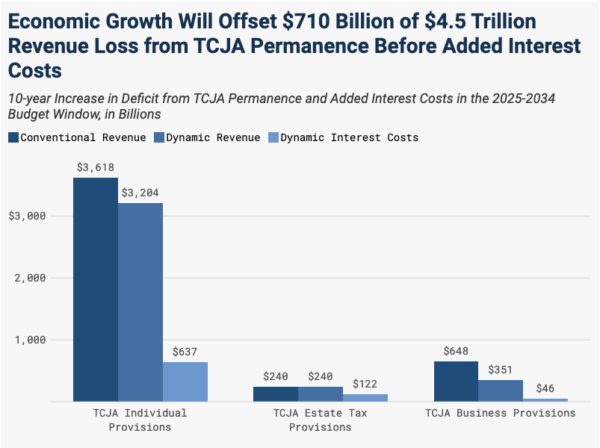
In addition to delivering the biggest economic bang for the buck, TCJA’s business provisions also deliver the largest revenue feedback effects compared to the individual provisions. The chart below shows that the conventional cost of extending the business provisions would raise the deficit by $648 billion over 10 years. However, the new revenues generated by the economic boost of extending TCJA’s business measures would reduce their static cost by more than 45 percent to $351 billion.
But as economically powerful as these measures are, it is also clear that they don’t pay for themselves. As the chart shows, making the business tax provisions permanent would still increase the deficit by $351 billion over the next decade which, in turn, would require additional interest costs of $46 billion. So even with the revenue feedback from economic growth, the business measures would still raise deficits by nearly $400 billion over a decade.
However, as we saw above, repealing C‑SALT could raise more than $430 billion over a decade, as measured on a conventional basis. Even if the dynamic score was slightly less, it is likely that it could fully offset the cost of extending these exceptionally pro-growth business policies.
Although this is not a true apples-to-apples comparison, the table below compares the two Tax Foundation scores to illustrate the potential net economic benefits of using C‑SALT to offset the costs of restoring TCJA’s business provisions.
Source: Tax Foundation General Equilibrium Model, February 2025
Using C‑SALT to Offset TCJA’s Business Tax Provisions Makes Good Fiscal and Economic Sense
| Economic Effects | Disallow Corporate SALT Deductions for Corporate Income and Property Tax | Restore and Make Permanent the TCJA Business Provisions | Net Effect of Using C‑SALT to Offset TCJA Business Tax Provisions |
|---|---|---|---|
| GDP | -0.2 | 0.7 | 0.5 |
| GNP | -0.2 | 0.6 | 0.4 |
| Capital Stock | -0.4 | 1.3 | 0.9 |
| Wages | -0.2 | 0.6 | 0.4 |
| Hours Worked Converted to Full-Time Equivalent Jobs | -46,000 | 176,000 | 130,000 |
| Revenue Impact | +$432 billion* | -$351 billion** | +$81 billion |
Source: Tax Foundation
*Conventional revenue estimate. Dynamic estimate not available
**Dynamic revenue estimate
Is it possible that some businesses may not be better off as the result of trading better investment treatment for a cap on their C‑SALT deduction? Yes, it is possible, as some corporations experienced after losing their 199-manufacturing deduction, even with a lower 21 percent statutory rate.
But lawmakers must make efficiency and economic growth the number one priority and live with the fact that some taxpayers may face higher tax burdens after tax reform because they have built their lives and businesses around deductions and loopholes in the tax code.
Even The Most Pro-Growth Tax Reforms Limit Business Deductions
Opponents of repealing the C‑SALT deduction say that state and local taxes are a legitimate cost of doing business and, therefore, should not be eliminated any more than tax reform should limit the deduction for salaries and wages.
This is a fair point. The corporate income tax is a tax on the net income of businesses, which is determined by deducting all business expenses from total income. Yet the design of many tax reform plans disallows deductions for certain businesses input costs.
For example, the tax reform plan known as the Destination-Based Cash-Flow Tax, or DBCFT, would limit various deductions for businesses. Indeed, DBCFT would disallow the deduction of imported items as a cost of goods sold. DBCFT uses this technique to effectively tax imports at the same rate paid by domestically produced products. Also, DBCFT would disallow a deduction for interest expenses in exchange for allowing firms to fully expense their capital investments and other business inputs.
Conclusion
Studies have found that states maximize their tax systems by shifting as much of their tax burden as possible to the federal government through the SALT deduction. The workarounds that state lawmakers devised for pass-through businesses illustrate this. Indeed, it is worth investigating how much state and local governments have shifted their tax burdens to businesses in the wake of TCJA’s cap on SALT for individuals.
Extending the current SALT cap to all businesses makes sense, not just from an equity standpoint, but also as a means of generating the revenues needed to offset more pro-growth measures such as full expensing and deducting R&D costs.
Tax reform requires tradeoffs. No solution is perfect. But lawmakers should lean toward tradeoffs that create the most economic growth and contribute least to increasing the national debt. Capping C‑SALT is a worthy tradeoff for extending policies that boost GDP, increase capital investment, create jobs, and boost wages.
This brief was authored by Scott Hodge, a tax and fiscal policy fellow in the Public Finance group at Arnold Ventures.